
Gaddha
For a split-second, we were flying. We—a group of women and daughters—were sitting in an e-rickshaw, our knees angled towards each other, hurtling over potholes in Okhla. We had hit a long stretch of an unpaved, bumpy road, with large hills of cement and gaddhe (potholes). Salma1 a woman in her thirties, laughed as the e-rickshaw lunged into the air, gripping her sister Heena’s arm tightly. ‘Okhla khokhla ho gaya hai! Okhla has been hollowed out!’ she exclaimed.
As the children screeched gleefully, I exclaimed, ‘Dhachka!’ This is a word they had taught me, for a bump in the road, a jolt. Heena grinned, ‘She has learned to speak like us! What is the word for dhachka in your German language?’ I thought for a minute, but to my embarrassment, I could not find the words. Heena laughed, ‘She has forgotten her own language, she has spent so much time here!’
I had been in Delhi for many months now—so long I sometimes lost count. I was doing ethnographic fieldwork for my dissertation, which revolved around a group of young Muslim women from working-class areas of Delhi and their transition from girlhood to adulthood. But as the months went by, instead of gaining clarity, I felt more and more disoriented; the outlines of concepts grew blurrier by the day, and I had lost the central thread. Those days, I wanted nothing more than to surrender to someone else’s plot—to a plot not of my own making. Just for a few hours, I wanted to quiet that voice inside me that asked, in increasingly desperate tones: ‘What is the story here? What will you tell them when you go back? What is your argument?’ Over the past many months, I had watched my research questions collapse like rows of dominoes, as lives spilled off of the page.
The story of today was about holes in the road, but it was also about marriage. And about getting a young woman’s life on track, seedhe raste par chalna, by getting her married to a good boy, a seedha ladka (lit., straight boy). And it was also about the in-between moments of life: the ephemeral thrills of travelling through the city.

As I journeyed through the city with these women, I had been thinking a lot about landscapes. When the parts of the story no longer seemed to coalesce into a plot, I thought about how incongruous things can hang together in a place, in an atmosphere.2 And so, I found that the antidote to my own growing vertigo was to join these women on excursions (ghumna) around the city. Though these outings happened infrequently, to go ghumna was a favourite activity of many of the women I spent time with. These women, who hailed from poor, predominantly Muslim neighbourhoods such as Nizamuddin Basti, Okhla, and Jaitpur, spent much time plotting the next opportunity to go ghumna, often concocting elaborate cover-ups for family members. Though ghumna was much desired, it was only sanctioned on special occasions. Holidays such as Eid ushered in a week of ghumna; women would often spend a week ghumne-ing around the city as a kind of honeymoon period after getting married. Though these moments were often experienced ephemerally, on a brief jaunt through a park or a moment of respite on a rooftop, they were enjoyed with much abandon.
Over the course of my explorations with these women, an affective map of the city emerged of their favourite places to go ghumna: biryani in Daryaganj, juice at the Juice Stand in Bhogal market, chasing hawa around tombs in Lodhi Gardens, eating golgappe at India Gate, the Delhi Zoo, Humayun’s Tomb, the Science Museum, buying butterfly burqas in Seelampur market. And so, it was through these outings that I became interested in how these young women read the city. They would often speak about the twisting turns of their life paths figuratively, using metaphors from the urban landscapes they traversed. They invoked the invisible presence of angels in the same breath in which they delivered detailed assessments of the cement mixtures that held their walls together; they reminisced about the mangoes in their villages while sitting in small, window-less apartments in the heart of the city.
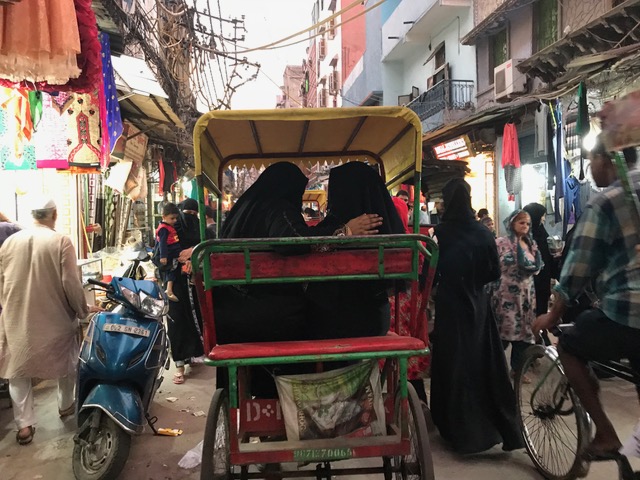
The journey over the bumpy road in Okhla was one of these excursions. Salma, her two daughters, her sister Heena, and I had just returned from Khureji, where we had gone to see a potential rishta (match) for Zoya, Salma’s husband’s sister. Zoya’s family had been trying to find a rishta for her for years, and Zoya was in her late-twenties now, which was quite late to get married. The visit had been good. Hasan, the potential match, had a stable job at a mobile phone shop, he owned his own apartment, he lived next door to a masjid, and the families knew each other from when they both lived in Nizamuddin Basti. Heena and Salma, who were both married, had enjoyed teasing Hasan, who was very shy and barely spoke.
As we left the bumpy area of Okhla, we hailed an auto rickshaw to take us back to Nizamuddin. I could tell the women were still in a boisterous mood from the outing. When the auto driver quoted an outrageous price to Salma, she barked at him: ‘Are, where are you taking us? London-Paris ja rahe hain, kya? Are we going to London-Paris?’
In the auto, we sped over flyovers with a view of the Yamuna. A pleasantly warm breeze engulfed us, flapping our dupattas every which way. It was 5.30, dusk, and everything was tinged with a golden glow. ‘Bahut mazaa aaya! Mind fresh ho gaya,’ said Heena.
Heena nudged me, ‘So? Did you like him?’ She was asking me what I had thought of Hasan. ‘He did not speak very much,’ I said. Salma nodded and said, ‘It’s a new relationship, so he is shy. He might have been a bit nervous.’ Heena said, ‘His face has radiance (raunaq) to it now. He has begun to look handsome.’
Salma reclined in the auto, her sleeping daughter in her lap. She winced briefly; she had recently tripped over a gaddha in Nizamuddin and twisted her ankle. ‘The galiyaan (lanes) in Nizamudin are very uneven. At least in Okhla the roads are all straight, so you can’t get lost. In Nizamuddin the lanes are all winding, tedha medha. Even after 14 years of living there, I still don’t know my way through the galiyaan!’ She began to lament that she rarely left the house, and that her husband never took her out ghumne. She lamented, “You know after marriage, I changed a lot. I don’t leave the house, I wear old clothes, my husband doesn’t take me out. I haven’t even seen Delhi’s main sites—I haven’t even seen Humayun’s Tomb, and it’s right around the corner from us!’
As we sped over flyovers, the wind became stronger, lapping our faces. I could only make out snippets of their conversation over the wind:
‘If Zoya marries Hasan, finally Zoya’s life will be on track (seedhe raste par).’
‘But the food was so feeka (bland)! How is Zoya going to manage?
‘How are things with your sister-in-law now, Heena?’
‘Better now. Gadi pehle kharab chal rahi thi, phir theek ho gayi. (The car was running poorly, but now it’s fixed.)’
As the wind roared past us, I thought about how these women often transposed metaphors from the built urban world onto the shifting topographies of their own lives. By drawing on travelling metaphors, involving vehicles, roads, and walking, these women poetically ruminated on lives that had followed the right path (seedha rasta) and lives that had been derailed.
Scene Change Hota Hai
On a hot Monday morning in July, I met Amirah and her mother outside of their home in Okhla. We were going on an excursion to visit Amirah’s friend Gulnaz in Khadda Colony, where she had just moved into a new flat with her family.
For Amirah and her mother, this visit was an excuse to go ghumna and see a new neighbourhood. Amirah and Gulnaz had met at an NGO-run school for young (mostly Muslim) women who had dropped out of the formal school system; they were now pursuing distance-BA degrees at Jamia Millia Islamia. Their mothers were illiterate and had moved to Delhi from villages in Uttar Pradesh in the 1970s and 1980s. Both Gulnaz and Amirah had grown up in various jhuggis in Delhi, and had only recently been able to help their families move into lower-middle-class areas.
Amirah and Gulnaz had been plotting this visit for weeks, but it had been difficult to find time—Gulnaz worked six days a week at a clothing shop in a market, and Amirah had been needed at home to cook for visiting relatives. As we shuffled along the shaded, narrow roads of Okhla, Amirah told me, ‘Ammi hasn’t left the house for days! It’s not good for her to be at home all the time.’ Kicking up plumes of dust with golden platform sandals, which she had worn for the occasion, Amirah lamented, ‘If it wasn’t for me, no one would take Ammi out to go ghumna. It will be good for Ammi to see a new area and to get a change of scenery. Scene change hota hai!’ In Okhla, Amirah made sure to take her mother, Ruksar, out on morning walks along the Yamuna. Today’s excursion was both a social occasion and an excuse to see a novel landscape.
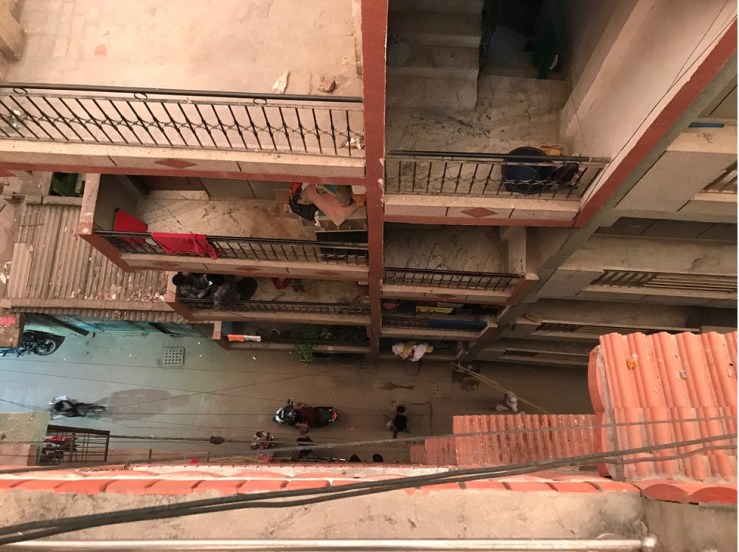
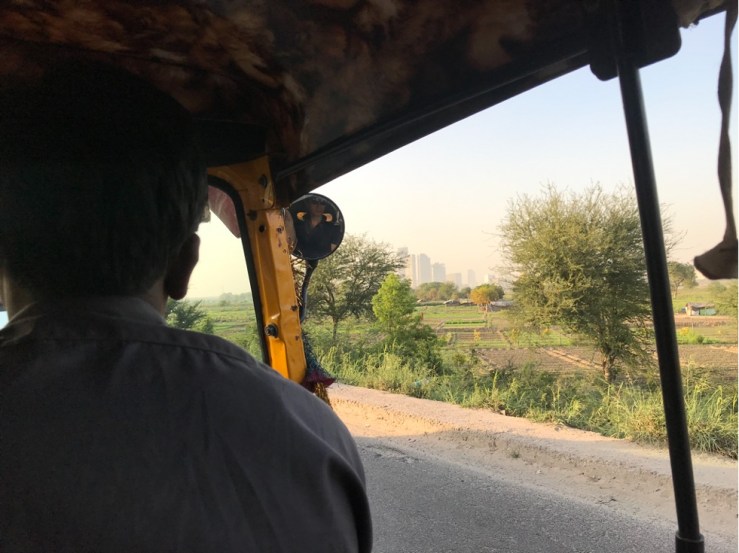
Though Khadda Colony was only about 9 km from Shaheen Bagh, the journey took 40 minutes. We edged along the tall metal fence that separates the Yamuna River from Okhla, side-stepping piles of trash, dodging cars and autos. We squeezed into an e-rickshaw with several middle-aged men, angling our knees away from them. I heard Amirah murmur something under her breath—she told me it was a prayer that she said before any journey, praying that the safar (journey) will be safe and peaceful. The road connecting Okhla to Badarpur Border—Jaitpur Kalindi Kunj Road—was one of the most incongruous roads I had seen in Delhi: it was elevated like a dyke above water. As we left the traffic-clogged roads of Okhla, suddenly the horizon opened up to vast green fields as far as the eye could see. Ruksar exclaimed gleefully, “Oooh, look at all this hariyaali (greenery)! Isn’t it nice?’ Amirah craned her neck out of the side of the auto, pointing out skyscrapers shimmering in the distance: ‘Oh, look, that’s Noida! Doesn’t it look nice?’ As we passed small farms, Amirah said, ‘Ah, this reminds me of travelling on mountain roads, because we are up high but there’s no fence.’ The landscape, she told me, reminded her of mountainous roads in Maharashtra, where she had spent a year living in a madrasa as a teenager.
We disembarked at Khadda Colony and walked to the neighbourhood market, where we found Gulnaz in a salon getting her eyebrows threaded. She was in a boisterous mood, teasing the young woman who was threading her eyebrows. We walked together through the bustling market, and as we made our way towards Gulnaz’s new flat, the road turned into mud. The area was still being built—most of the roads were kaccha, and the horizon was a zig-zag of half-built, one to three-storey buildings. Gulnaz, who was the main breadwinner of the family, had recently moved her family—her mother, father, sister, and two brothers—to a small house in a sparsely-settled jangal (forested) area of Badarpur Border, on the Haryana side. She had been overjoyed, at first, to have been able to buy her own place—apna ghar—after living in a one-room flat in Sarai Kale Khan, near Nizamuddin Basti. But when her home flooded during heavy monsoons in August, the police evicted everyone from the area, and Gulnaz and her sister Sufiya quickly rented a new flat in Khadda Colony, on the Delhi side of Badarpur Border.
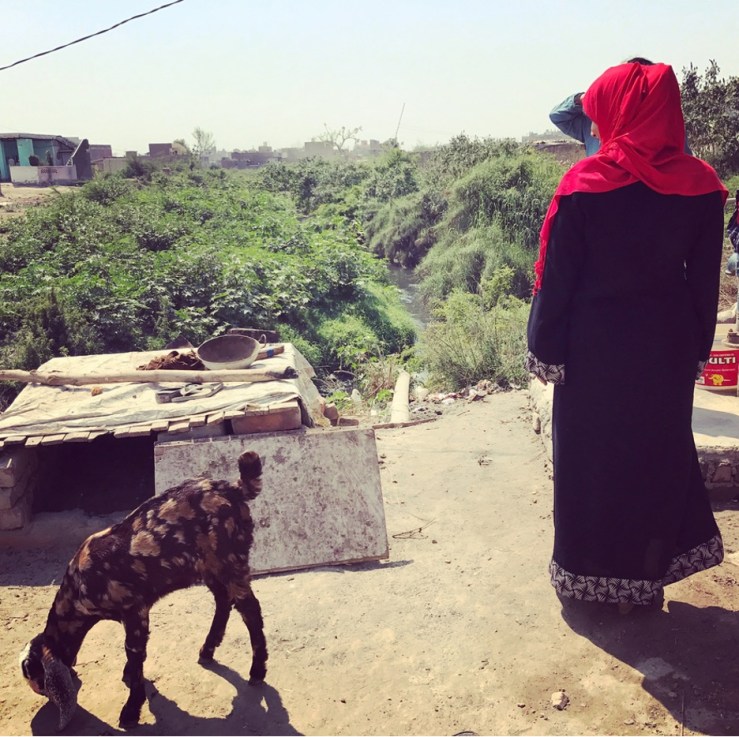
As we trudged through the mud, Gulnaz pronounced to me, smiling, ‘Thalia, this area is much better than Badarpur Border. Life is going on very peacefully here! Yahan sukoon se zindagi kat rahi hai!’
Sab ban raha hai; sab gir raha hai
As we entered the new flat, Ruksar stood in the hallway, removing her burqa, taking the place in. Nusrat, Gulnaz’s mother, came to greet us. There were three rooms, and the front room had large windows and an open balcony. ‘Bahut accha hai. I like it very much,’ Ruksar said. ‘Everything is open. There is a nice breeze, you don’t need a cooler!’
Amirah yelled to Gulnaz, who had rushed to the kitchen to prepare food, ‘Hey girl! Does the light go off here?’ Gulnaz yelled back over the hiss of the pressure cooker, ‘Yes, but not as bad as the place in Badarpur. We went for days without electricity there!’ Ruksar asked Nusrat, ‘Is there a masjid? School? Hospital? A market?’ Nusrat nodded. ‘Okay, then it’s good,’ Ruksar pronounced.
Ruksar stepped out on the balcony and surveyed the jagged skyline of half-built buildings. ‘Yes, right now it’s all being built. Sab ban raha hai. Right now, it’s all open (khula), but soon everything will be built up and closed (band),’ she said, meaning that the open view would soon be filled with buildings, like in Okhla. Nusrat came to the balcony and yelled out to her son Shaheed, ‘Pyaaz lo! Get onions!’ I marveled at the fact that she could yell to her son and find him; this would never be possible in Okhla. Ruksar continued to ponder the view from the balcony: ‘When you come back again after a few years, it will look just like Shaheen Bagh!’

We went back inside and sat on the cool marble floor. Ruksar lamented, ‘Are, there’s no land left in Delhi…nothing’s left! I remember when Okhla was all jangal.’ Amirah and her family had spent much of the first 20 years of her life moving from jhuggi to jhuggi. As they circumambulated the city, being forcibly evicted from slum after slum, their only fixed point was the neighbourhood of Nizamuddin, to which they would return for brief periods of time to seek refuge (often staying with Ruksar’s family). Ruksar recalled when, in the early 2000s, Okhla was still part-wilderness: sand-swept, unpaved roads, dotted with a few slum settlements. With some trepidation in her voice, she recounted how she had almost lost her daughters when they had first moved there: ‘I remember one Eid, we had just moved to Okhla Vihar—Amirah and Nazia had Eid outfits, but they were not very nice. So, I sent them out to get new ones. After a while, I began to get worried, because a lot of time had passed and they hadn’t come back…it was all jungle out there, and I had heard there had been a murder recently. I began to think to myself, I should have just let them wear the old Eid outfits, what did it matter. When they finally came back, I was so relieved.’
Gulnaz’s mother, Nusrat, said, ‘Yes, now, everything is being built in Delhi, they just keep building and building. Sab ban raha hai.’ Gulnaz mentioned a building that had collapsed the day before in northeast Delhi; six residents had been killed. Ruksar said, ‘Yes, these buildings collapse all the time. Sab kuch gir raha hai.’ Nusrat nodded and said, ‘Yes, that’s true, our landlord in Sarai Kale Khan built another floor on the first floor, and it collapsed, and one of the residents died.’ Ruksar said, ‘Because you know what they do, they create a fake masala (mixture) out of cement and something else and it’s kaccha ….’ Nusrat tapped the walls of the new flat and said, ‘See, this is masala, too. It all is around here!’
The incongruous image of the simultaneous building and collapsing of buildings, evoked by these two women who had seen so many homes, neighbourhoods, rise and fall, lingered in my mind.
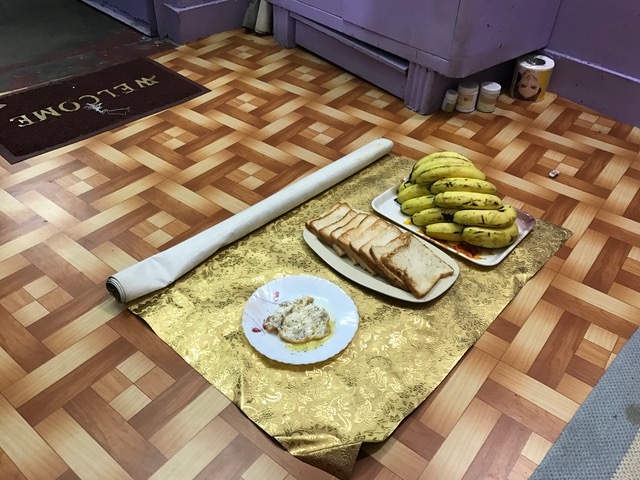
Gulnaz was still cooking up a frenzy in the kitchen. She yelled from the kitchen, apologizing for the time it was taking to make the food. ‘Are you sure you’re not hungry?’ She yelled. Amirah, yelled back, winking at me, ‘No, it feels like our bellies are being filled by the smell of your cooking.’ A few minutes later, she brought over the food, and we all sat eating on the dastarkhaan.
It was July, monsoon season, and a strong storm had swept through Delhi and Uttar Pradesh. Gulnaz burst out in mid-bite and said, ‘Do you know, the wind was so strong yesterday at Central Market, several trees fell over! I don’t understand—how is it that we humans don’t fall over from the wind, but trees do? Are we stronger than trees?’ Amirah and I giggled at Gulnaz’s incredulous tone. Ruksar said knowingly, ‘In my village, when strong winds came, people would hold on to trees to steady themselves.’ Ruksar would often refer to her natal village near Lucknow, which she and her family visited about once a year. Often, when we spoke about the weather in Delhi, she would remark on the weather in her village, and she now immediately remarked on the effect the recent storm would have had on her village: ‘All of the crops will have gone bad.’ Like Amirah evoking the mountain landscapes of Maharashtra on the road to Khadda Colony, elderly women often transposed village landscapes onto urban spaces.
As we started to get ready to leave, the sky outside darkened. Amirah peered into the sky, which was suddenly full of heavy rain clouds. ‘Have you ever seen peacocks dance?’ she asked me. I said no, I still hadn’t seen their mating dance where they fanned out their plumage. I had heard it was beautiful. She smiled. ‘They usually do their dance right before a downpour. Like right now. It is so pretty.’ She told me that she would see peacocks daily when her family had lived for a while in Chiragh Dilli, in the wealthy bungalow of her father’s boss.
On the auto ride back to Okhla, we travelled again on the incongruous road. The sun was setting, and the heavy rain clouds turned purple-pink. Amirah assessed Gulnaz’s new neighbourhood, saying to me, ‘Khadda Colony is good, it’s much better than where Gulnaz lived before, in Badarpur. Badarpur is quieter than Okhla, but it’s…a different kind of quiet. It’s not a nice kind of quiet, because there’s no one around. I could never live in a place like that because there are not enough people. Okhla is quiet too, but at least there are lots of people. The Okhla market has a lot of raunaq (radiance, effervescence; a busting conviviality). I think, soon, Khadda Colony will have raunaq, too.
—Thalia Gigerenzer
Thalia Gigerenzer is a social anthropologist, writer, and audio producer based in Princeton, New Jersey. She is interested in atmospheres, emotions, urban life, everyday poetics, conviviality, and experiences of wonder.
Cover photograph: Fields on the way from Okhla to Khadda Colony.
All photographs, courtesy of the author.
Note
- All names have been changed. ↩︎
- Kathleen Stewart writes about how an ‘atmosphere’ is not an ‘inert context’ but a kind of ‘force field’ in which ‘incommensurate elements’ can co-exist. Kathleen Stewart. ‘Atmospheric Attunements’, Environment and Planning D: Society and Space, 29 (3), 2011, pp. 452–3. ↩︎

 Chiragh Dilli