on my block, a gate
on my block, a tree smelling
of citrus & jasmine that knocks
me back into the arms of my dead
mother. i ask Ross how can a tree
be both jasmine & orange, on my block
my neighbors put up gates & stare
don’t like to share, on my block
a tree I can’t see, but can smell
a tree that can’t be both but is
on my block, my mother’s skirt twirls
& all i smell is her ghost, perfume
on my block, a fallen orange
smashed into sidewalk
its blood pulped on asphalt on my
block, Jordan hands me a jasmine
by the time i get home
all its petals are gone
—Fatimah Asghar, ‘Smell Is the Last Memory to Go’
I step out of the airport and I smell it. The smell of this city. A smell, sometimes overpowering, sometimes restrained, but always there, irrespective of the weather. A constant through scorching heat, thunderstorms, stifling humidity, cool breeze. A smell not yet annihilated by the mutating cityscape that aspires to be ‘any city, anywhere’ through the proliferation of generically ugly glass and concrete edifices. A smell that brings a smile to my face. The smell of almost belonging and never-quite belonging, the smell of being in the hometown. Bhonsar. Bhubensar. Bhubaneswar.
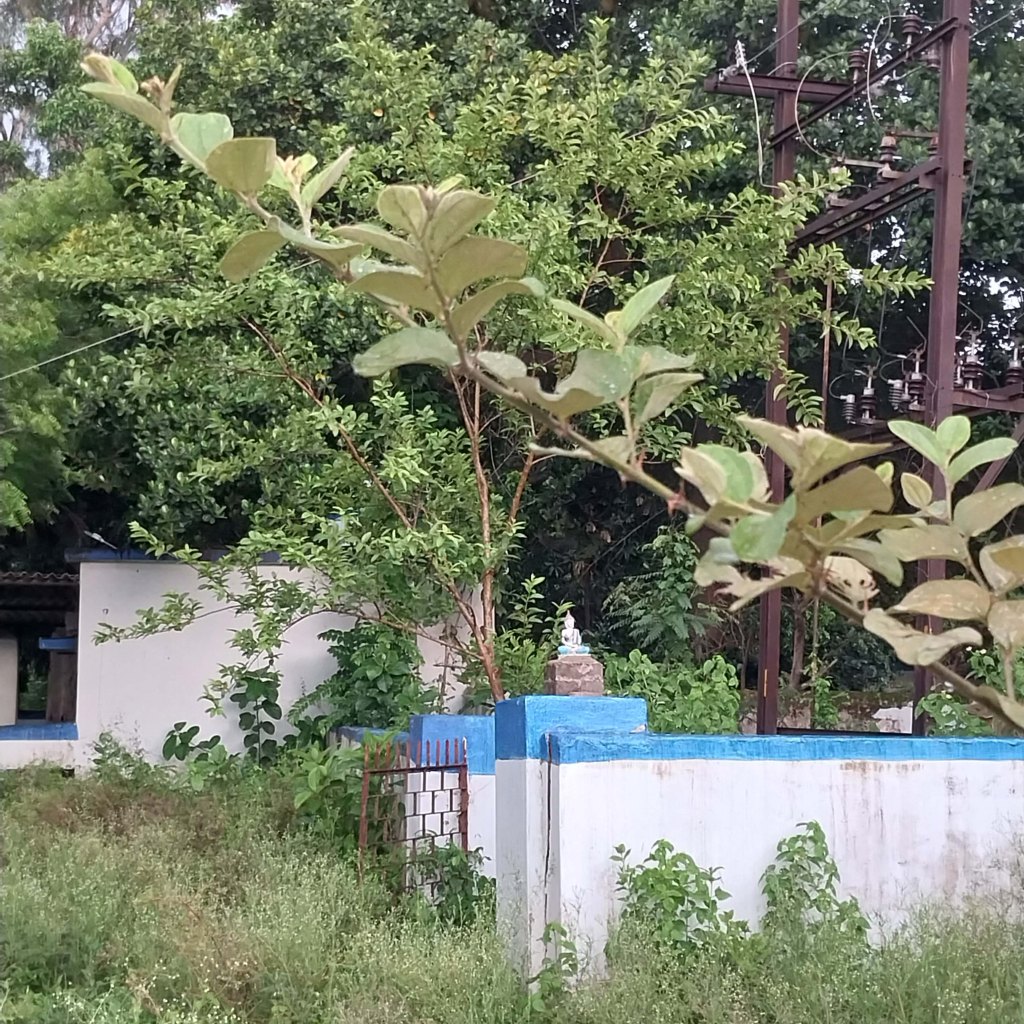
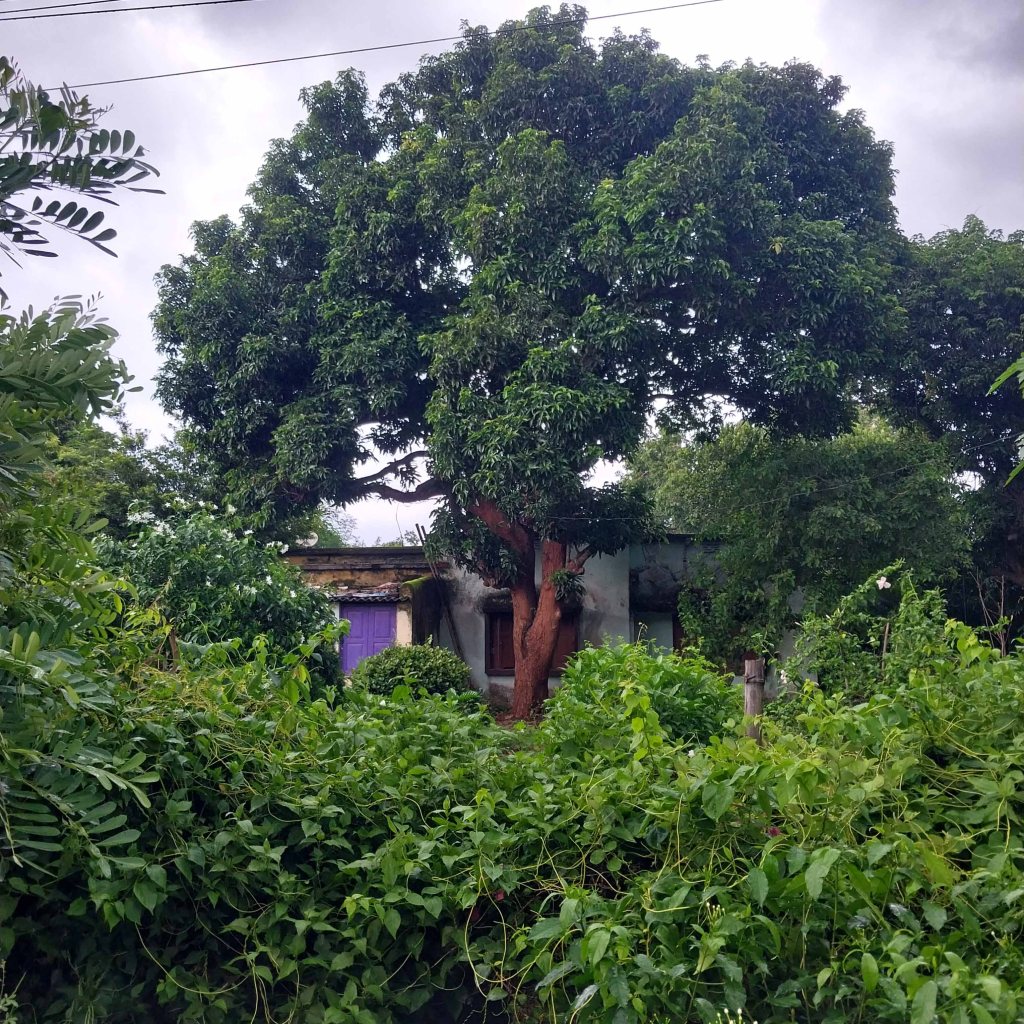
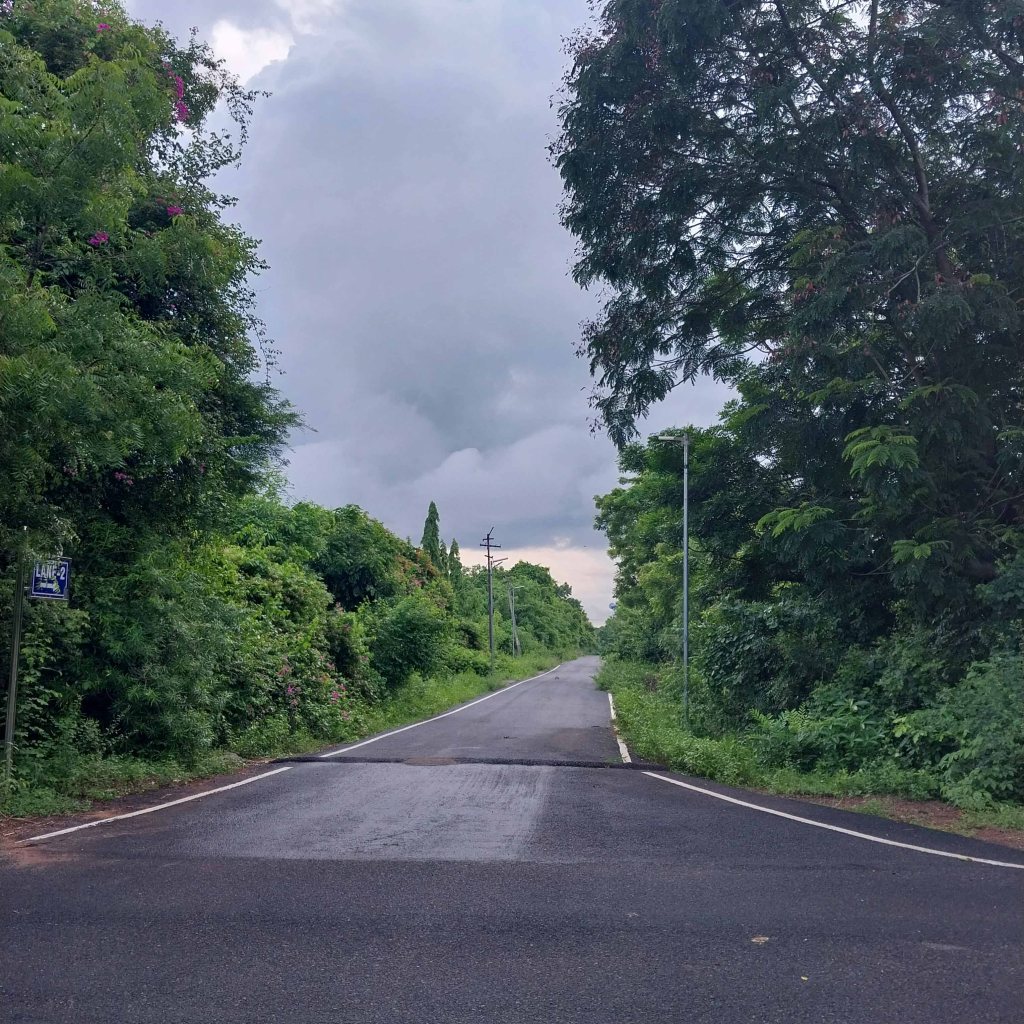
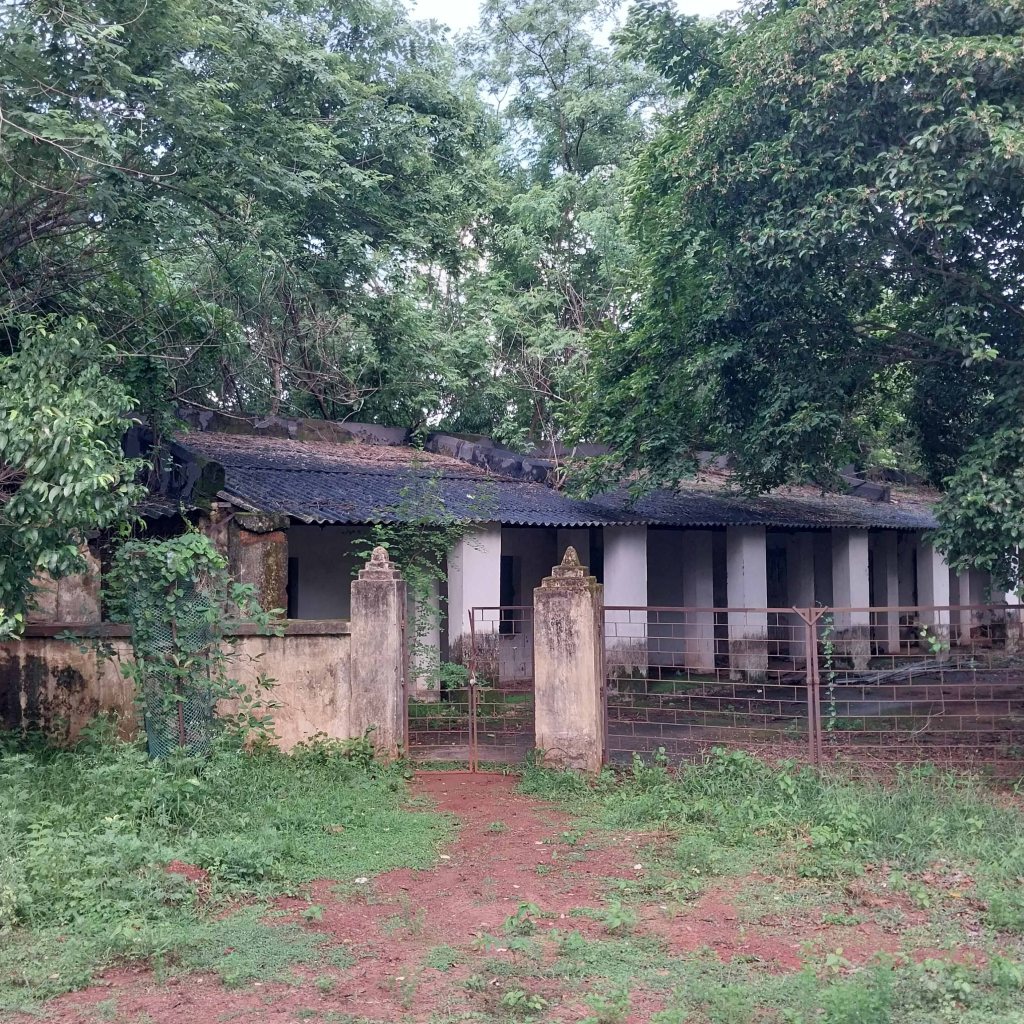
Walking in Vani Vihar, the campus of Utkal University. Despite rampant construction, the city still has clusters of dense foliage that become even more lush in the monsoon.
It’s earthy and sweet, I’d probably say if someone insisted that I describe it. Over the course of returning to the city, again and again, I have tried to deduce the components of this tangible yet elusive smell, much like how I reconstruct the ingredients and recipe of a dish I’m tasting for the first time. A handful of coconut trees, a dash of the not-too-far-away and not-too-close-by sea, a sprinkling of the melancholic gangasiuli, a smattering of lush and partly trampled undergrowth, and mildew according to taste. And the main ingredient—generous dollops of red laterite soil, colloquially known as mankada mati, lit. monkey soil, possibly a reference to the bright red colour of rhesus monkeys’ bottoms!
This red soil can leave stubborn stains, on the underside of shoes, on clothes, palms, and nails. If it’s part of your childhood like it was of mine—summers spent playing in and with it, mixing different proportions of water to it, endlessly fascinated by the resultant concoctions of slush and sludge—it’s also something that sticks to your memories. My sister would eat handfuls of the soil while we would be out playing. In monsoons, the puddles of rain mixed with that soil had an uncanny resemblance to kheera cha—CTC tea boiled with milk and sugar, the form of tea favoured in most Indian homes. A favourite trick of my mud-devouring sister was to serve the tea-coloured rain water in our ceramic toy teacups to unsuspecting relatives and house helps. I was more discerning about what I put in my mouth or served to others, but that soil and its fragrance has been a part of my body, deeply intertwined with my childhood, the landscape I grew up in, memories of the place, the smell of the home left behind, and the marking and muddling up of time through countless arrivals and departures.
The olfactory sense, like any other sense, does not function in and by itself. It works associatively with the other senses as the body, with its specific abilities and constraints, interacts with the materiality of the world, forming, building upon, cross-pollinating endless loops of sensory experiences, layers of memories, maps of loss and longing. I seem to have a special relationship with smell though. My friends tell me I have the nose of a dog. When my friend Nishpriha was living with me for a while in Delhi, I could make out what she had cooked (or burned) in the day as I would be climbing the stairs to my second-floor house in the evening, and I would promptly announce it when she’d open the door to me. Apart from a keen sense of smell, I also just don’t get along with some kinds, which can cause anything ranging from mild discomfort and nausea to severe migraines and swollen lips. And it is always smells of the fragrant kind that elicit such reactions: perfumes, agarbattis, and room fresheners, but also that of some of my favourite flowers, jasmine and rajnigandha. I sometimes assume something doesn’t have a smell if it doesn’t make me sick. For the longest time I believed that lilies have no smell till someone corrected me. As an anthropological object, smells tend to be analysed in terms of their classification and taming through modern sanitary and health regimes or in terms of social norms and frictions, particularly in the context of the politics of food. But smells are also deeply connected with individual relationships and personal biographies even as these are located in socio-cultural and political settings.
I can sometimes smell in advance of actually smelling something or sighting the source of the smell. For instance, when I am walking from IMFA park towards my parents’ home in Sahid Nagar and before I can see the gupchupwala in front of the school at the end of the road. Or when I am about to cross the H&M store in Sahid Nagar, where my sister’s favoured gupchupwala sets shop. The skin on my arms tingles and my mouth salivates in anticipation of the smell of gupchup, whether I choose to eat or not eat.
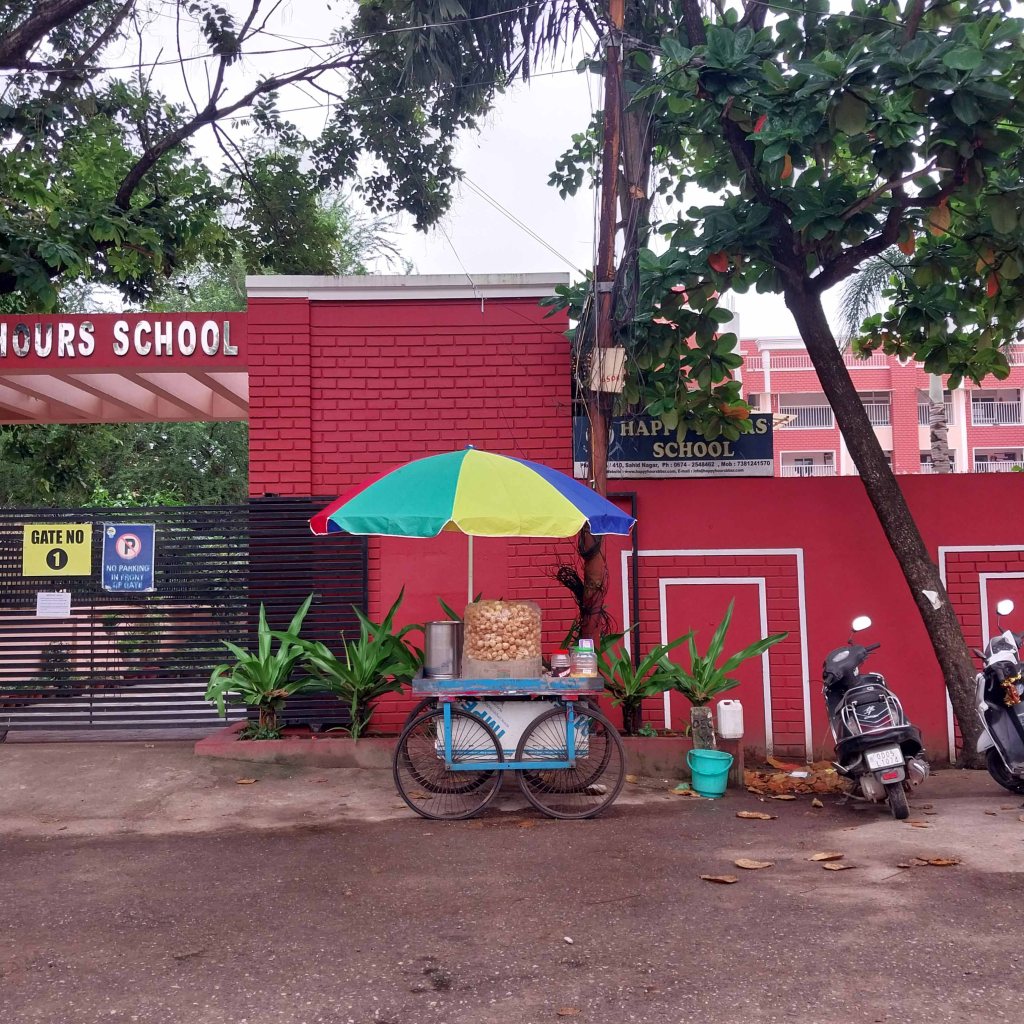
Gupchup stall waiting for me as I walk back home from the park, Sahid Nagar.
The act of eating gupchup is possibly most illustrative of how the senses are conjoined and heighten each other. The nose and mouth explode in flavours—of raw onions, mashed boiled potatoes and yellow peas, fiery chillies, tentuli pani or tamarind water with the distinctive raw mango aroma from amba kasi ada, the crispy fried puri, secret masalas, the hands and sweat of the gupchupwala. The eyes tear up, the ears start twanging, parts of your face sting as you wipe your mouth and tears, and even the brain seems to buzz! Every act of eating gupchup or passing by a gupchupwala in Bhubaneswar or of longing for it tugs together a host of childhood memories in which my sister and I are co-conspirators—waiting for the gupchupwala to cross our house, eating stealthily acquired gupchup from a steel tiffin box late at night while sitting on the bed with the mosquito net around us, saving two rupees for two plates of gupchup and walking to the Sahid Nagar Haat outside which were just a handful of chaatwalas and one gupchupwala.
The Sahid Nagar Haat of my childhood has been displaced by the BMC Bhawani Mall (which opened in 2012) and split into Chota Haat and Bada Haat in two different locations in the neighbourhood, a casualty of the neoliberal city that splits and shrinks, divides and devours. A melange of street food stalls has mushroomed outside and around the mall, selling tea and cigarettes, a host of local fried snacks but also a burgeoning repertoire of ‘cosmopolitan’ snacks—Manchurian–paratha, tandoori momos, corn chaat. While these stalls rupture and provide some relief from the staid aesthetics of the smart city, their collective smell, if there is one, is disorienting for me. Much like the excessive and continuously changing wall art in the city, loved by visitors to the city, but confusing for me as I try to find my bearings and my way around the city.
I miss the simpler and easily discernible smells of the handful of chaat and gupchup stalls of the undivided haat of my childhood. And, suddenly, I feel older than this city.
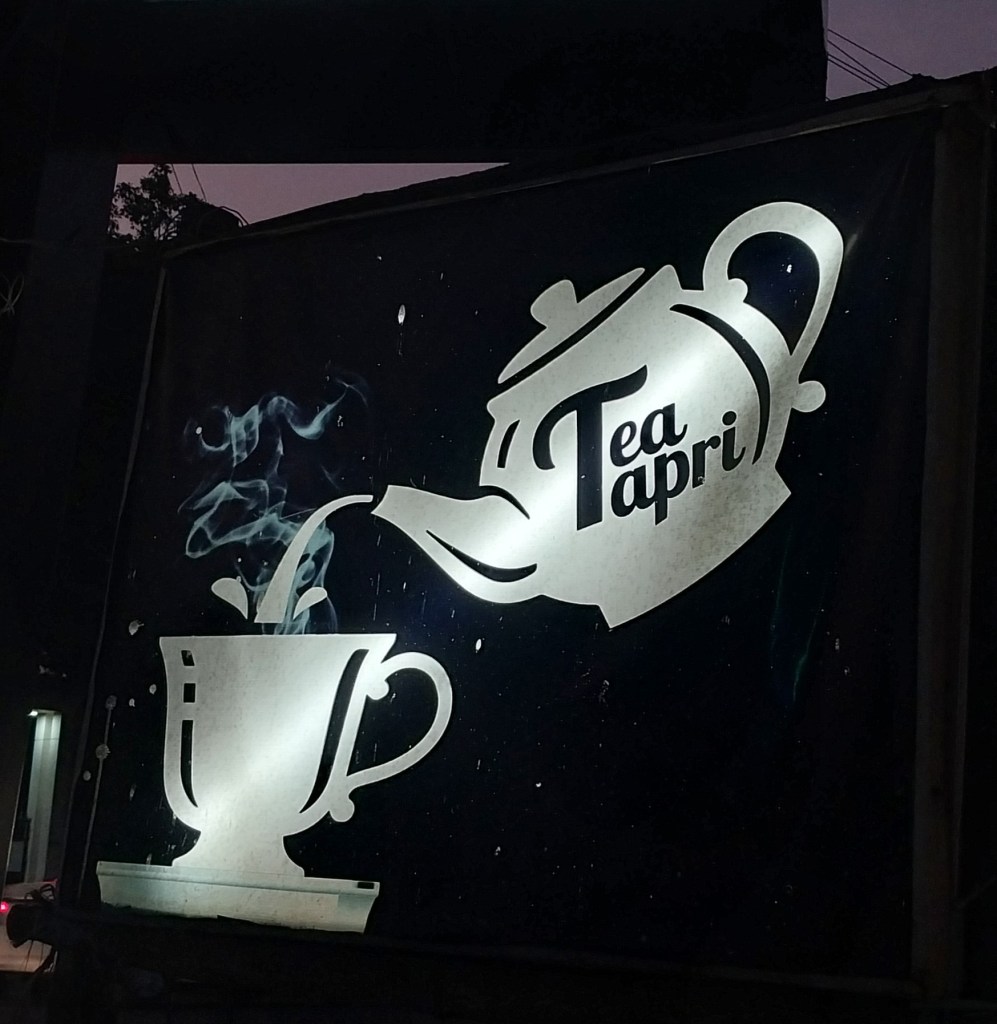
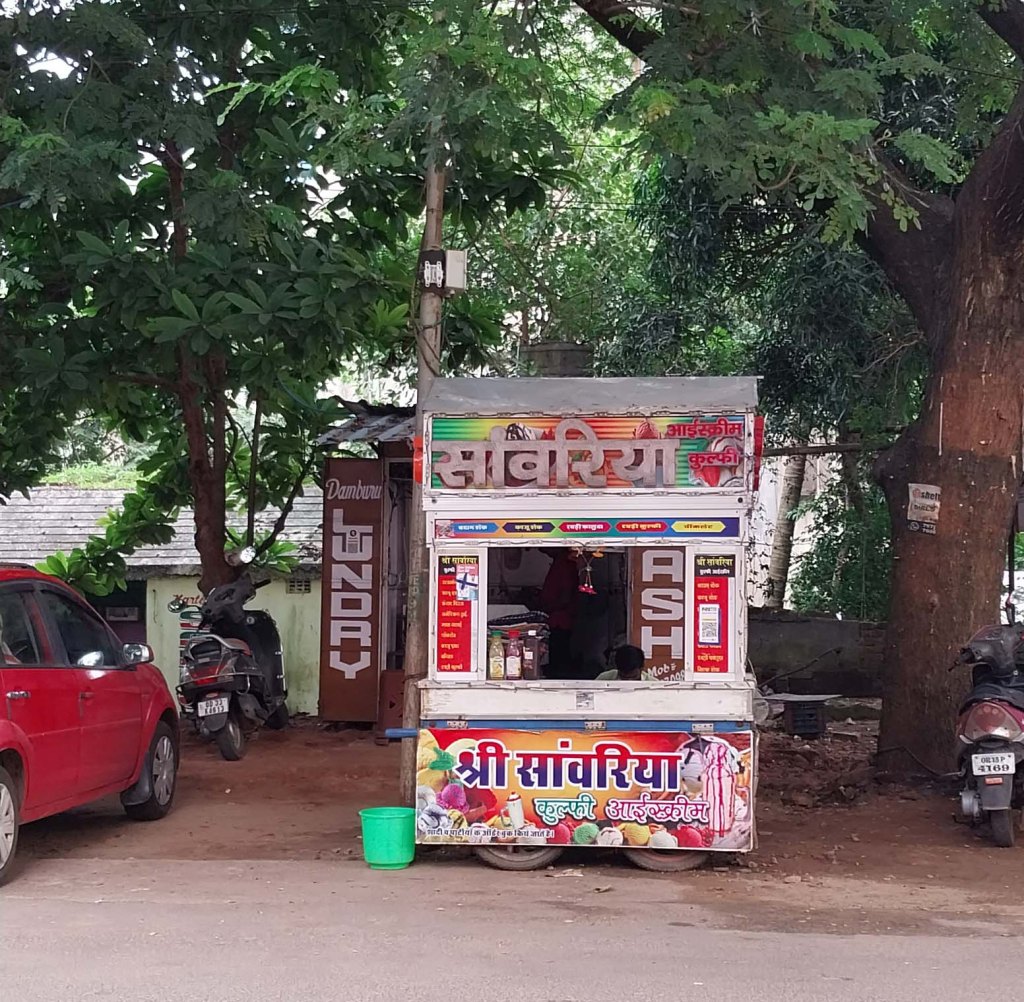
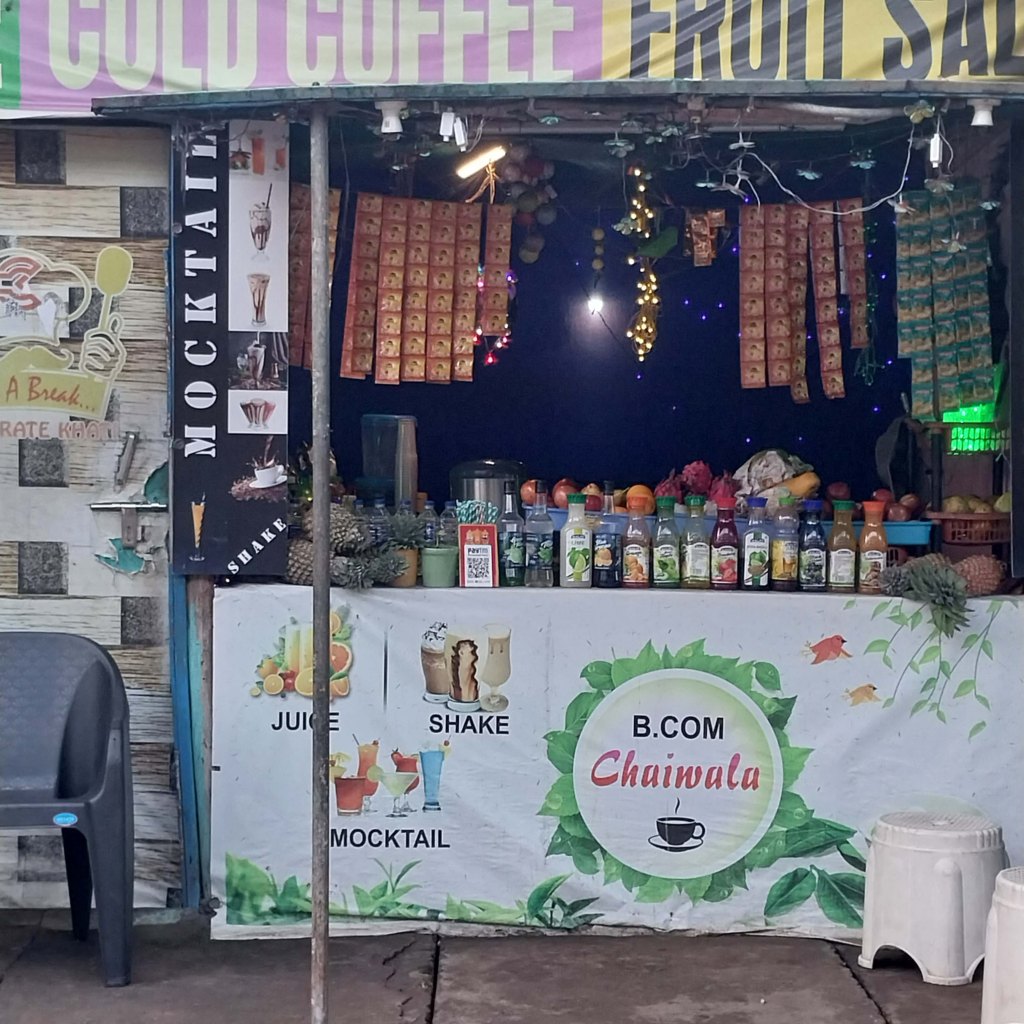

The changing landscape of street food stalls in Bhubaneswar. Many of these stalls now use Hindi terms, such as ‘tapri’ (tea stall) and ‘sanwariya’ (beloved or the dark-complexioned one, a reference to the god Krishna; also the title of a Bollywood film), in their signage, a mark of the changing demographic of the city with its transition into both an educational and IT hub.
Sometimes, I see before I smell. A scattering of tiny white flowers on the road. I can smell the rain and the wet compost in the adjacent park, not the flowers. I look up and notice the tree laden with dense clusters of these tiny flowers. Teak. I pick up one flower with one hand and gently put it in the palm of the other and feel its weightlessness. I bring it closer to my nose. The fragrance is sweet, wispy. I put it away in my bag where it will be crushed against the hand sanitizer, strawberry lip balm, used and unused tissues, crushed bills, and other bits and bobs. But I am also filing it away in the vials of my memory, as I reprise the smells of this city. This city whose roads and buildings, shops and markets are transforming at a pace I can’t keep up with. This city in which the last of my grandparents is no longer there. This city in which Papa is not waiting at home, who upon my return from anywhere in the city without him would want to know every detail: where did I walk, what route did I take, what did I see, what did I do, what did I eat, what did I think of this or that.
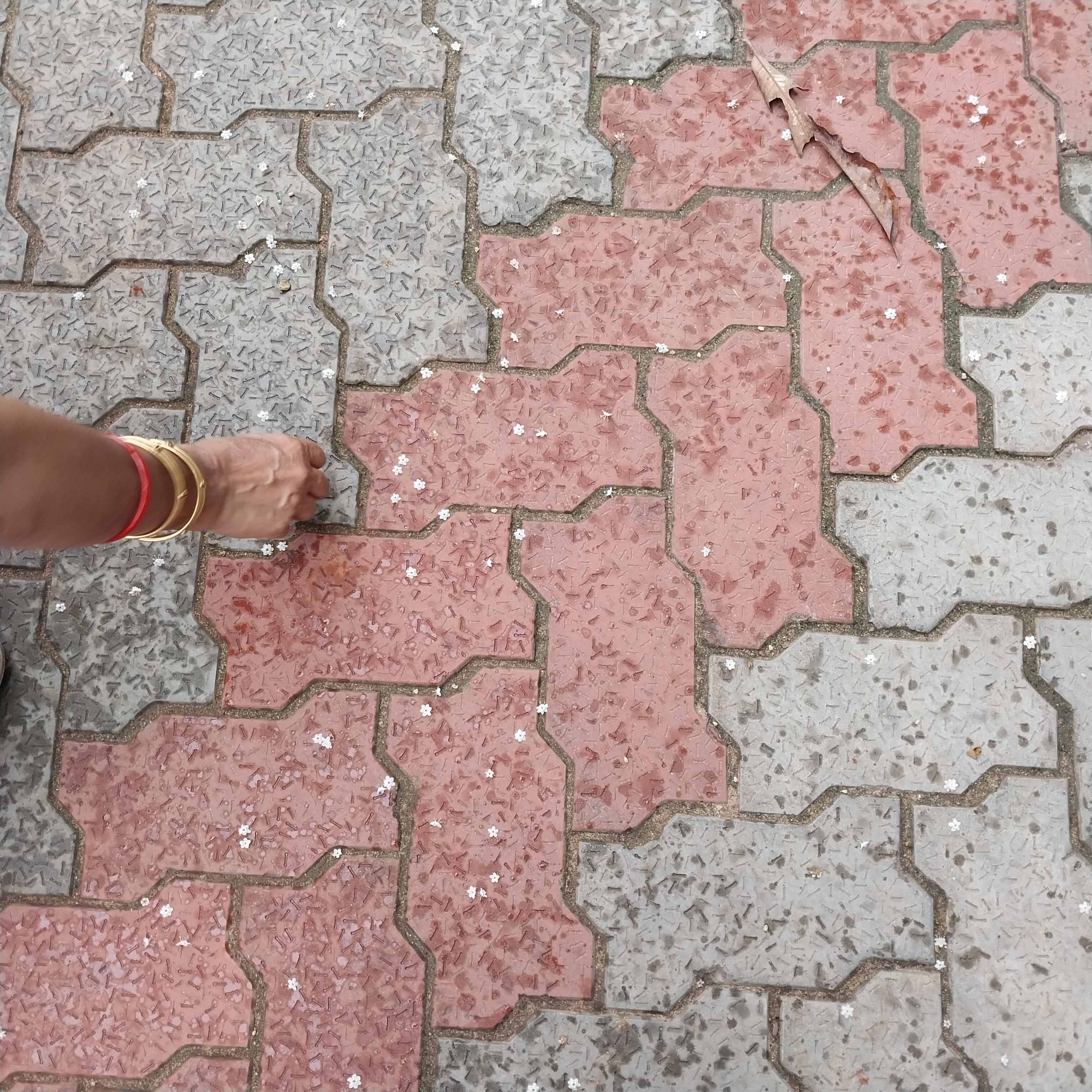
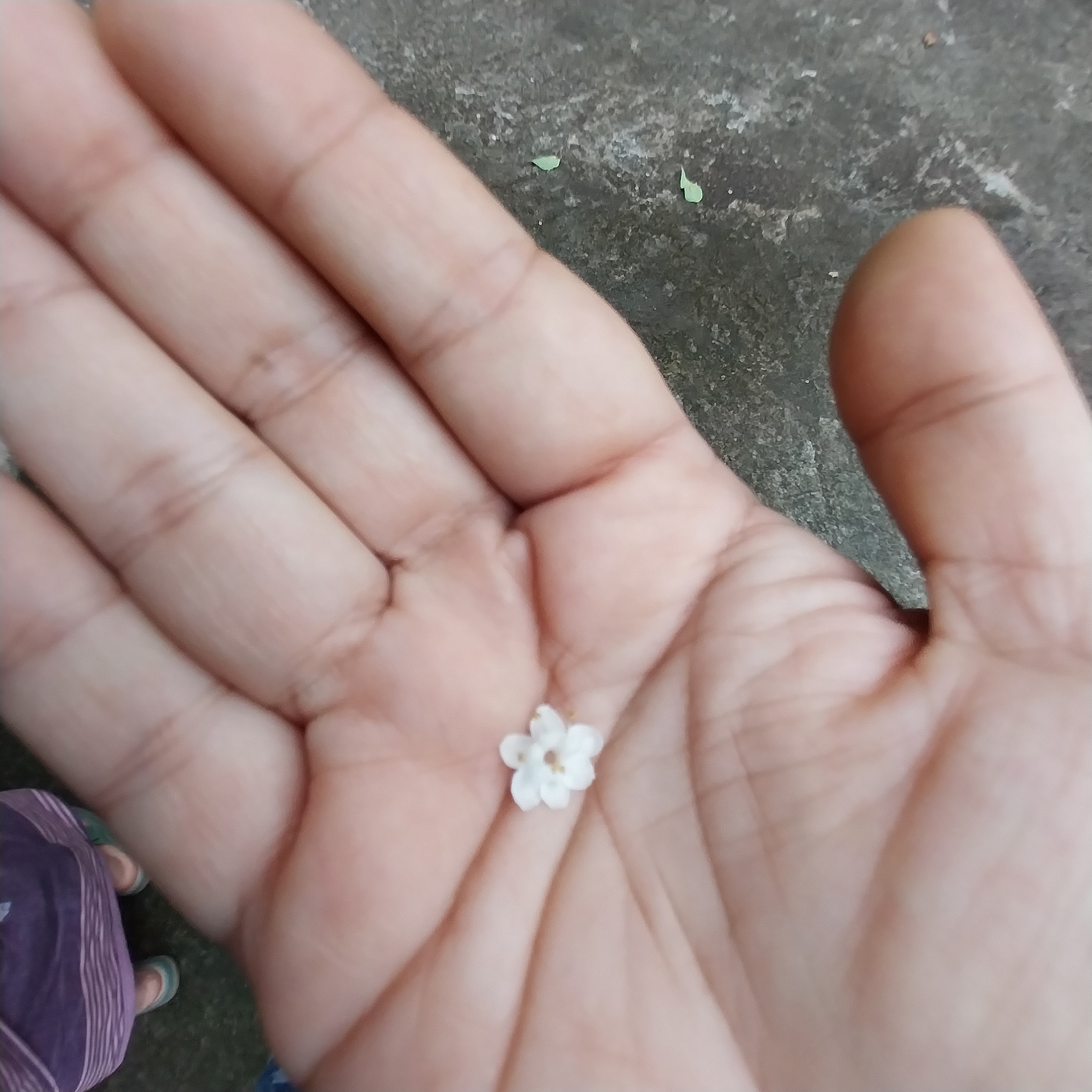
Pausing for the teak flowers.
The teak flowers were a pause in the walk from one Mamu’s house after lunch to another Mamu’s house in the same neighbourhood. The latter is actually my maternal grandparents’ house, and even though neither is around, I still refer to it as Aja–Aai ghara. This might be the last time I see this house. It will be torn down to build a multi-storied apartment block, the fate of most old single and double storied houses in older neighbourhoods of the city with the passing away of a certain generation, out-migration, and private-builder spurred real-estate development.

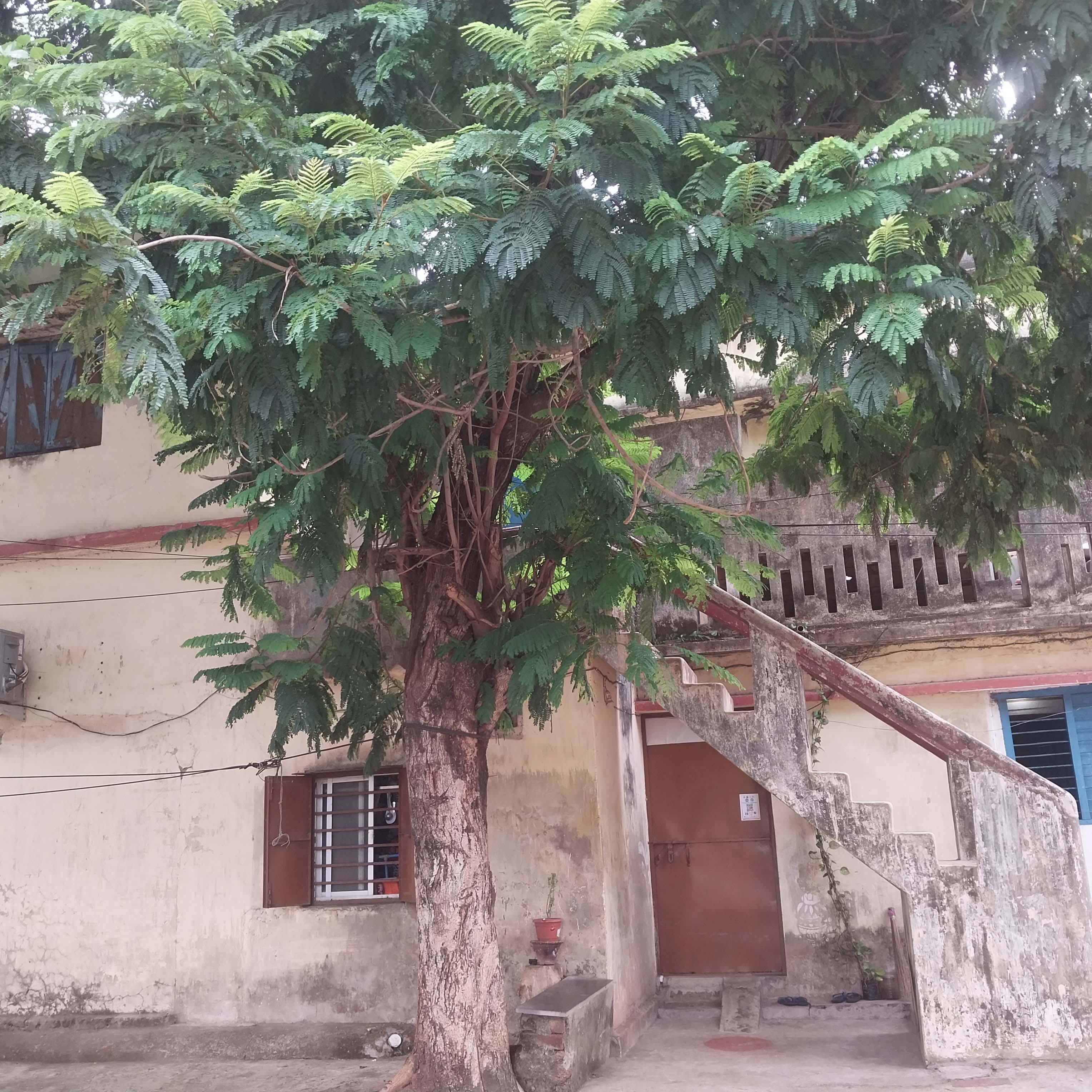
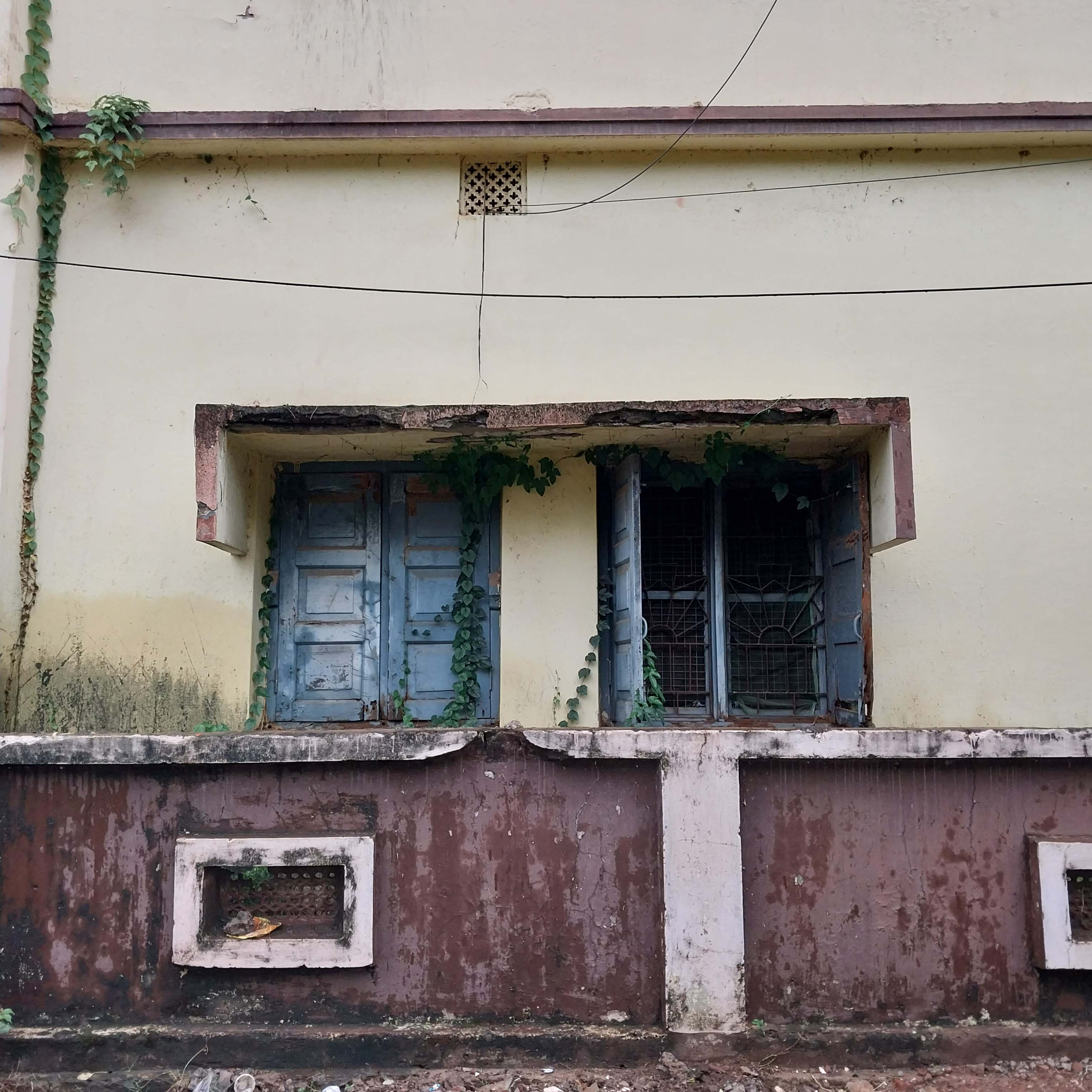
Left: Hoarding for an upcoming luxury apartment complex in Sahid Nagar, Bhubaneswar, but the advertisement is so generic, it could be located in any city anywhere in India. You know a city has arrived when it offers ‘bespoke’ residences and asks you to ask your ‘assistant’ to get in touch with the builder/developer. Right: Older houses that have survived in their somewhat original form in the same neighbourhood.
I don’t need to enter Aja–Aai’s house to smell its smells. I might not have spent a lot of time in this house in the last many years, its smells might have changed, its inhabitants shrunk, but the scent of a childhood spend here is neatly bottled away in the head, even if it has gotten somewhat fainter with the passage of time. The most prominent smells are of a wide range freshly cooked food, not all muddled up, but wafting outwards one after another, some gently overlapping others, some more distinct than others—kheera santula (boiled vegetables simmered in milk and mildly tempered with whole spices), pithau bhaja (an assortment of vegetables, such as pumpkin, brinjal, and yam, shallow fried in a light coating of rice ground with spices, chhatu rai (straw mushroom in a mustard paste gravy), fish or prawn curry, and much more. Then there’s the background smell of the house—a mellow combination of sandalwood, the sweet smokiness of a lit ghee-lamp, fresh and rotting flowers, and tulsi from the puja room. And the most reliable smell, that of Aai, without which all the other smells of the house would not hold shape: the smell of Vicco Turmeric cream, traces of washing powder, the dogs of the house she loved and cared for, and the betelnut and slate lime from the paan she relished. Within her smells were buried the expectation of listening to her stories. Stories of magical parrots, of the escapades of travellers and adventurers, and, my favourite kind, of an assortment of different kinds of ghosts, with distinctive quirks and powers.
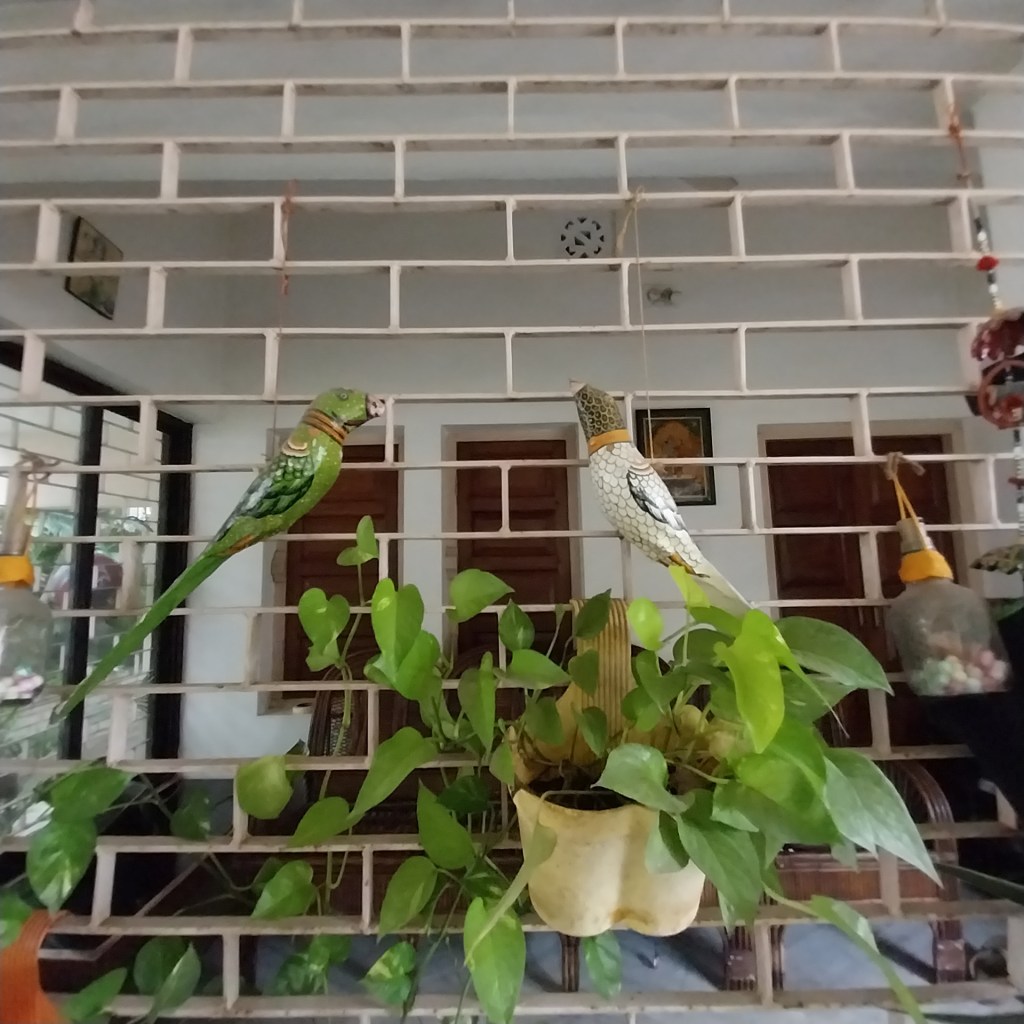
My favourite story was of a particular kind of female ghost who’d come to the rescue of a (human) woman who either didn’t know how to perform household work or simply didn’t give two hoots. The ghost would clean and scrub and make the house sparkle and make delicious food on behalf of the woman, making the woman’s husband love and appreciate her. I don’t remember the exact details of the plot of this story, though I think it usually ended with the ghost being vengeful when the woman would break the promise of not revealing the ghost’s existence to the husband. What I remember distinctively, however, is how the story would conjure up tantalizing smells when Aai would list the many savoury snacks and sweets the female ghost would rustle up—smells of fried batter and of sugar and chhena or cottage cheese in different combinations. The dishes would vary with different iterations of the story. The ones I remember are pakudi—a deep fried fritter of vegetables in chickpea flour, with the distinct flavour of chopped curry leaves and crushed garlic, bara—bite size urad dal fritters with a hole in the middle, seasoned with chopped onions, curry leaves, and ginger or mango ginger; it has a sweet variant in which small roundels of the lentil batter are deep fried and then dunked in a sugar syrup, chena gaja—a dense sweet made by boiling rectangular pieces of a doughy chhena and semolina mix in a thick sugar syrup, chena podo—a blend of chhena, semolina, and sugar traditionally wrapped in banana leaves and fired in an earthen stove, resulting in a delicate sweet that’s soft on the inside and caramelised on the top. The story of the female ghost has lasted in some fragments in my memories through the distinctive smells of the food in the story, though the versions of the dishes, their tastes, and their recipes are probably those of my childhood and those made by Aai. The smells have intermingled and kept alive my memories of and connections with food, a beloved grandparent, stories, and the place I grew up in.
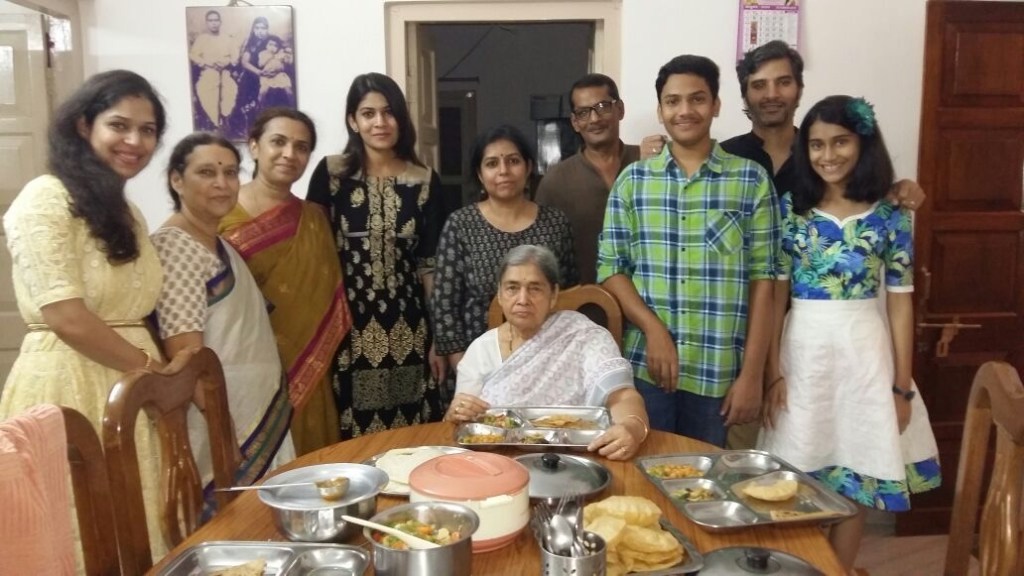
Gathering around Aai (seated) and gathering around food.
It is not surprising that so much of the smellscape of my childhood in Bhubaneswar revolves around food. While we may or may not be aware that we sense with all the senses, we most easily conjoin taste and smell, experience them simultaneously, and find it difficult to split the two. The association of taste and smell also extends to language, though the correspondence between the two is more complex in this case. For instance, khatta (sour) in Odia is both a taste and a smell, the latter used in reference to the smells emanating from citrus fruits, various pickled and fermented foods, and even rotting vegetables and fruits (some fruits, like jackfruit, emanate a sickly-sweet smell on rotting though). The object of a khatta smell, however, may not be limited to food items. The smell of sweat is also referred to as khatta. ‘Ainsinia’, meaning characteristic of ainsa or non-vegetarian food, refers not to the aroma of cooked food but rather the slightly unpleasant smell of raw fish, seafood, or meat. A piece of clothing having gotten repeatedly wet in the rains can also be said to emanate an ainsinia smell, as also a floor cleaned with a mop that has not been dried between uses.
It has been argued that language by classifying, boxing, and analysing the senses strips them of their sensuality. But perhaps the opposite is also true, especially when it comes to smells. We not only have limited terms to describe smells but also language falls short when it comes to capturing all the sensations, affects, and associations involved in smells. Smells are ephemeral because they are constantly in flux—on the move, forming and dissipating, joining up with, or overtaken by other smells, making it difficult to tie them down with words. They are mostly described not in terms of themselves but in terms of something else: what it is a smell of (an object) or a smell like (associated with but not limited to an object). The smell of champa, of crushed undergrowth, of the sea, of sukhua or dried fish, of Aai’s stories, of a ghost passing by. Also, something smelling like a dead animal, like aloo chop being fried, like overripe mangoes, like longing, like a secret.
An object itself might derive its name from what it smells like. The brown marmorated stink bug is called padra poko in Odia, lit. farty insect, on account of the smell it emanates on being touched or crushed as a defence mechanism against predators. In my childhood, when I’d be playing be friends or cousins, if one of us farted they would be teased mercilessly for being a padra poko. Sometimes, however, the perpetrator of a particularly stinky fart would try to shift blame to a padra poko sauntering close by. More often than not though, the mere sighting of this bug was thrilling, resulting in the simple chant ‘padra poko, padra poko, padra poko’, just the sound of the words and their association with farting making us squeal with laughter.
Would the innocence and joy of these childhood antics be more powerful or more meaningful if I could describe more precisely the smell given off by the sting bug?
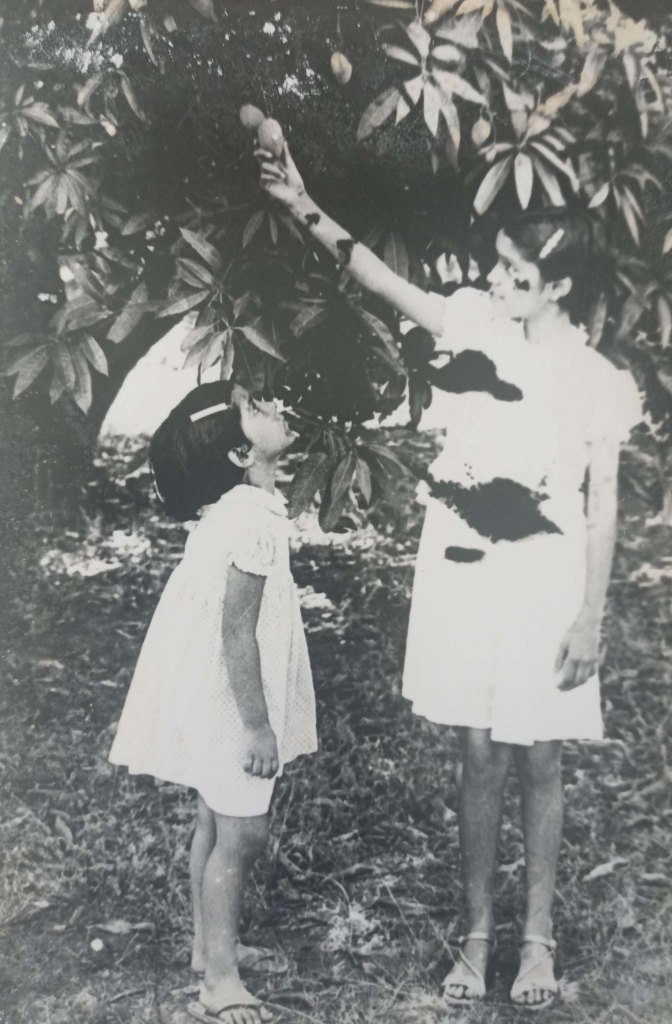
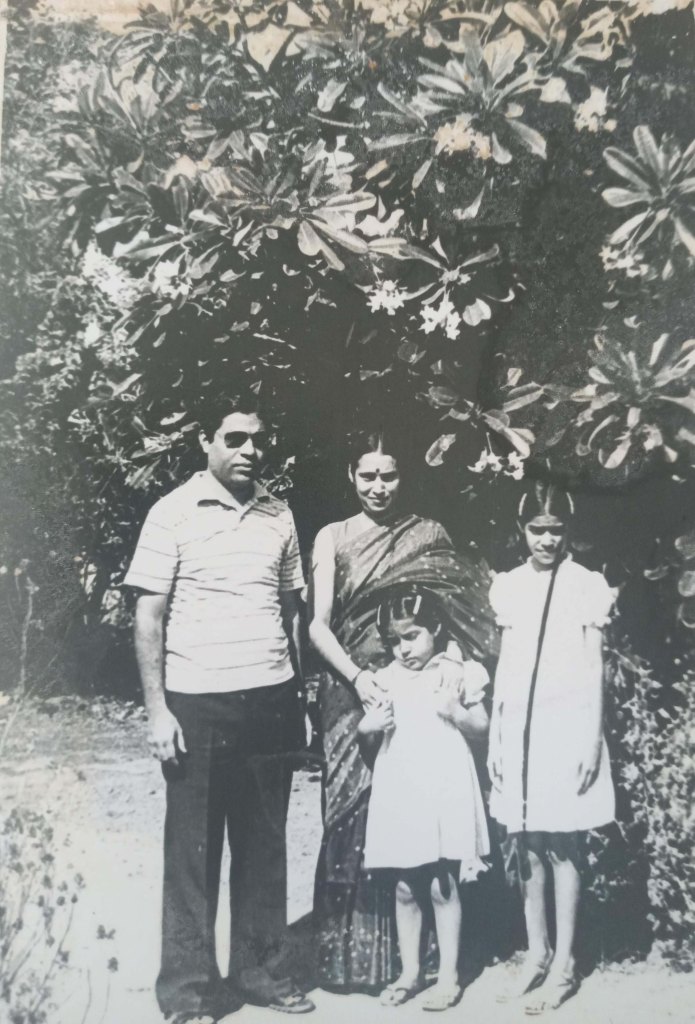
Left: Me (left) and my sister under a mango tree. Right: With Papa, Mamma, and my sister, and champa trees in the background. Both photographs were taken in our Unit 1 government quarters. So many of the photographs of that time have the trees of the garden as the setting.
Does the ephemerality of smells and the inadequacy of language in describing smells actually make smells more potent, evoking intense melancholia or joy, triggering déjà vu, or causing unease at not remembering something properly yet feeling it intensely? Is this why we attach layers and layers of other markers to a smell to make it more tangible? The smell of mankada mati, for me, is inseparable from the colour red and the stubborn stains the soil leaves. It is also inseparable from so much else: All the trees and fruits and vegetables that flourished in the houses I grew up in—pineapple, tamarind, guava, mango, drumstick, tomatoes, jasmine, champa, hibiscus, sapota, neem. The creatures that lived amidst these trees and sometimes lost their way into the house—scorpions, snakes of different sizes and colours, monitor lizards, mongoose, chameleons, tree frogs. The ghosts of Aai’s stories but also those that lurked on trees and behind the windows of our house (these were female too!). The innumerable creepy crawlies and bugs and insects that were impossible to keep out. Hot afternoons spent reading a book under an umbrella stuck inside the ground. Walking from Sahid Nagar all the way to Unit IX and back with Papa, he with his steady pace and non-stop chatter, at a time when there was no possibility of me imagining that he would grow older or battle a debilitating illness or one day simply not be there when I would be back here, stepping out of the airport and smelling this city. This city—my hometown for eternity, even as home is elsewhere and the town has long sprawled into a city with no limits and an insatiable taste for forests and fields, villages and water bodies.
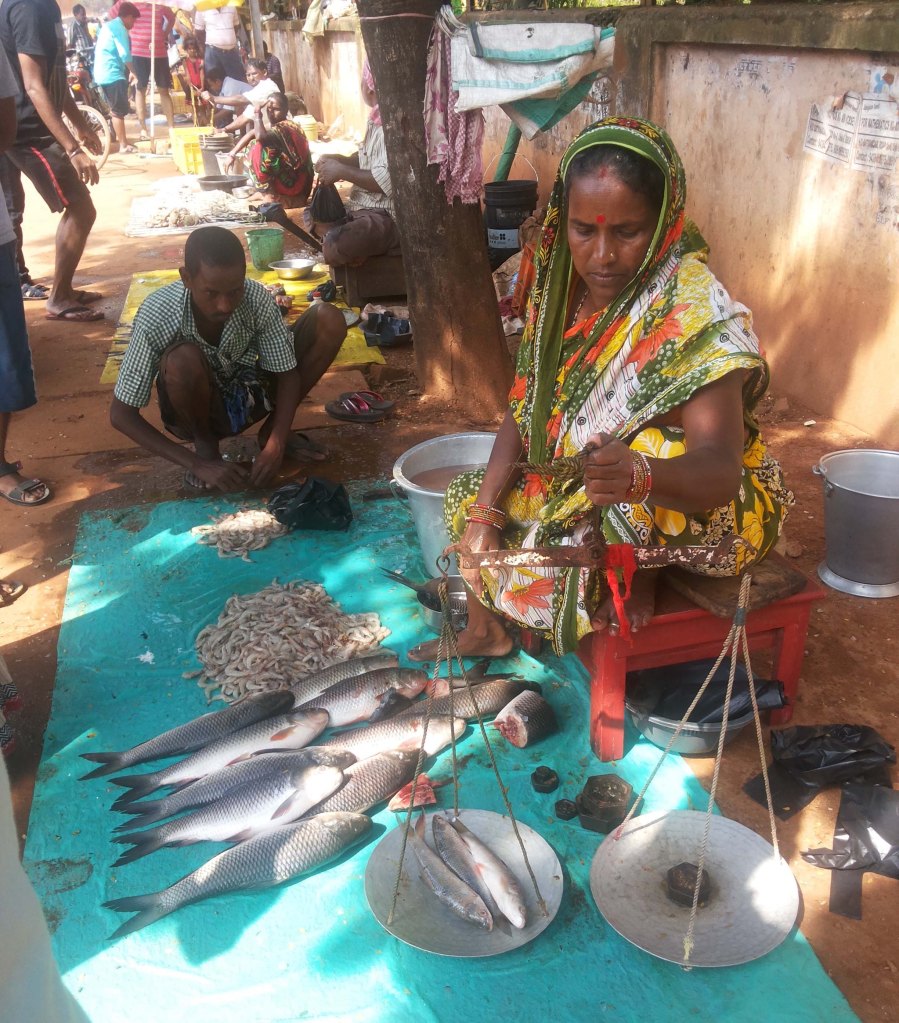
Shopping for fish with Papa after one of our long walks. At the time the photograph was taken neither of us ate fish but liked shopping for it for the house.
Some years ago, when I was in Bhubaneswar, I was seeing off a friend of my father at the gate. In the course of the lingering around that is part of saying goodbye, this elderly gentleman asked me if I’d noticed how developed the city had become and he went on to point at the wide, well-maintained road in front the house, the landscaped and paved park opposite us, and so on. And then he paused, scrunching his eyes, and said, ‘Why have they not extended the road to the edges?’ He was referring to the unpaved strips of land on the two sides of the road, which had weeds, plants, and trees growing on, and was a preferred spot for street dogs to rest on hot days. I said, ‘Uncle, where will the rain water drain off?’ ‘No, no, no, it should be paved till the edges or else there’s too much dust around!’
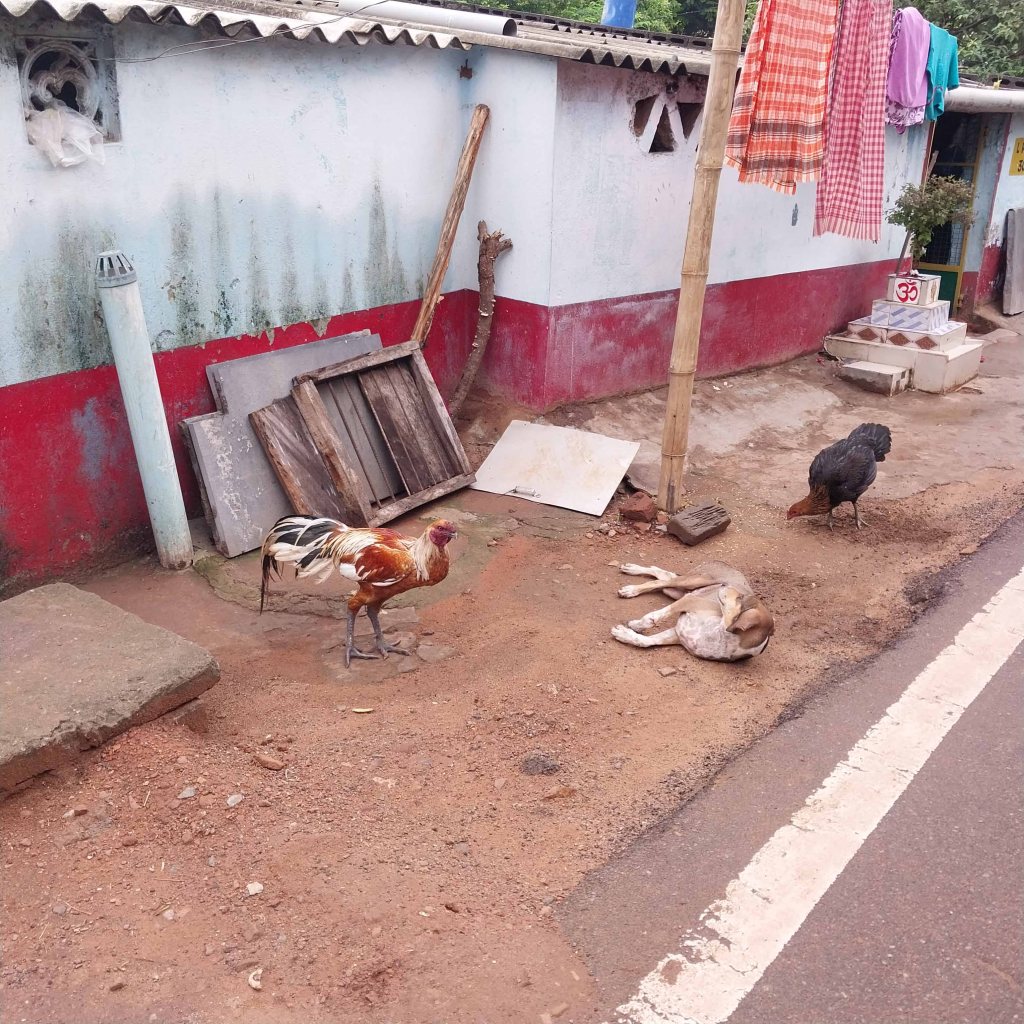
Uses of an unpaved strip adjacent to a paved road, Maitri Vihar, Bhubaneswar.
As the number of people that I come back to see in the city is shrinking as are patches of unpaved ground in the city, I wonder how long I will continue to smell the red earth that holds together so much of mine that has already passed. Or will I smell it in its absence, like the dishes in Aai’s story? Where will the smells of this city go then? This city where I no longer live, but return to, again and again. This city that I’m itching to run away from, once I’m here, only to then long to come back to. This city of disappearing loves and disappearing earth. Bhubaneswar. Bhonsar. Bhubensar.
—Samprati Pani
All photographs by Samprati Pani.


