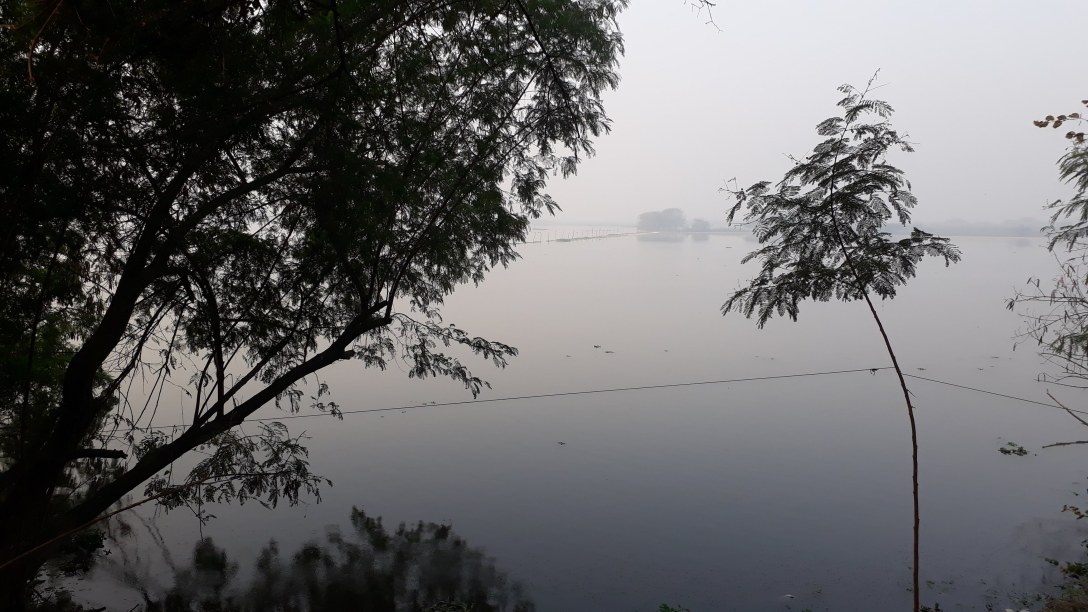
Iโve been thinking about windows. Since I moved cities, Iโve been thinking about windows. And looking at and through them. Through this looking, I move forward with time, sometimes attempt to hold it still, and at other times, let it take me elsewhere, to a time that has passed or is perhaps waiting for me. Some windows and their views remind me of other windows in other places, including windows that live in books and films, all real because of the feelings they evoke and the meanings they reveal or donโt. I write this piece as live in a new city, with curiosity and hesitation, looking at it through its windows and through the other windows these open up.
Author: Samprati Pani
The Years
I know it is weird to divide my almost three decades in the city into before, during, not-quite-over, and after the pandemic, but I find myself increasingly slicing and muddling my life into these time frames. Conversations, memories, friendships, the logbook of losses, mood swings, even dreams, appear to be structured by these frames. This piece reflects on my years in the city and grapples with the relationship between longing and loss, forgetting and remembering, even as I know well that this relationship is unstable and contradictory and can never be resolved. This relationship does not dwell in the realm of my imagination. I live and feel it, and I will forever draw and redraw its contours and trajectories, mourning the impossibility of returning to that which is lost, and often not knowing what it is that I long for. There is no cure for this affliction.
Beyond flรขnerie: expanding the horizons of walking, part I
I have a certain discomfort with the realization that the literature on walking, whether in the form of narratives, fiction, histories, or manifestos, is overwhelming from a Western context. Moreover, this body of literature often conceptualizes walking as intrinsically subversive, desirable, special, and/or worthy of emulation. This discomfort has led me to seek out books on walking in non-Western contexts, especially South Asian. The idea behind this is not to uncover more โauthenticโ modes of walking but rather to understand the situatedness of walking in particular kinds of places, people, and practices. It is instead to draw attention to and learn from ways of walking that donโt neatly fall into the categories most overrepresented in the literature on walking: flรขneuring, loitering, leisure, an art form, an experiment. This listicle of six books, written in two parts, is a tiny fragment from my archive of books on walking in various Indian contexts.ย
Meeting place
Is love and concern for writing and for cities enough to continuously create, manage, steer, and run something? And what is this โsomethingโ? The blog is just the form, but what is it that I am, we are, making? Is it an archive that holds together a scatter of words woven into stories connecting spaceโtimes? Is it a process of collaborative thinking and doing? Is it a โmeeting placeโ, much like the street corner, where ideas, people, and relationships intersect, partly by intentionality and partly by chance?
Walk economy
Far from disappearing, pedlars have a pervasive presence in citiesโaround busy intersections such as traffic signals, metro stations, tourist spots, bus terminals, railway stations, religious places, public parks and monuments; within residential localities, neighbourhood markets and industrial areas; outside office complexes, educational institutions, hospitals, shopping centres and even malls and supermarkets.ย They ply an entire gamut of trades from knife-sharpening, shoe polishing, miracle cures and ear-cleaning to providing chai and snacks, as also a wide range of commodities. This essay is a response to the images captured by Gopal in his city Mumbai, from the location of my interest as an anthropologist in forms of walking in the city as well as the associational life of streets around the locus of economic activities.
A view from across the riverย
On the face of it, Patparganjโs apartments appear to be small islands, each holding together a set of people with a shared social background. And there are apartment dwellers, who manage to unlook and avoid the sea of life the islands are surrounded by, through the blinkers of their class and aspirations, shopping for vegetables and eating street food from the evasive confines of their cars or seeking the โhappening cityโ elsewhere. Yet, life here, as I have come to experience over the years, does not inevitably have to be one of isolated living confined to the apartments.ย
Hunny ka chuha
If it is indeed the same chuha, it is back with a vengeance. Its earlier avatar was well behaved. It would stealthily come out at night after Hunny went to sleep and would rarely leave telltale signs of its dinner, except sometimes half-eaten bananas. This one does acrobatics through all times of the day, leaping over masala jars and knocking them off, smashing Rooafza bottles, scurrying over the bookshelves, chomping on electricity bills and doing cartwheels on the sofa. It eats everything โฆ potatoes, lids of Tupperware boxes, newspapers, phone chargers, books and unopened biscuit packetsโyou name it! It prefers to shit on the bed or on freshly laundered clothes. And it is BIG.
Letter
Mayaโs Curse
โSo you want to know who Maya is?โ he breaks the awkward silence. Trying not to look frightened, she clears her throat and manages to mumble a โYesโ. โThe problem with you youngsters is that you donโt know the stories that rule this city. Never mind โฆ youโre probably the only one of these people dying to meet me whoโs not interested in some quick-fix solution for health, prosperity or love. You may not be aware, but youโve come searching for a story โฆ and Iโd love to tell it โฆ itโs been such a long while since I've told a story. But I have a condition.โ โWhat?โ she asks. โYou cannot interrupt my storytelling and you cannot ask any questions after Iโm done.โ
Donkey
This time Nana Saheb seems to have picked up a bigger stone than before. He aims it at the dog barking from the opposite terrace. The dog has been watching this drama of fistfuls of air being aimed at him for a week now. And he is no longer afraid of the old manโs fake… Continue reading Donkey
Corona Diaries
The hour from night to day. The hour from side to side. The hour for those past thirty. The hour swept clean to the crowing of cocks. The hour when earth betrays us. The hour when wind blows from extinguished stars. The hour of and-what-if-nothing-remains-after-us. The hollow hour. Blank, empty. The very pit of all… Continue reading Corona Diaries
Thereโs something about the street
โI? I walk alone; The midnight street Spins itself from under my feet; When my eyes shut These dreaming houses all snuff out; Through a whim of mine Over gables the moon's celestial onion Hangs high.โ โโSoliloquy of the Solipsistโ, Sylvia Plath, 1956 โI do not know which of us has written this page.โ โJorge… Continue reading Thereโs something about the street