‘Tell me about your despair, yours, and I will tell you mine.
Meanwhile the world goes on.’
—‘Wild Geese’, Mary Oliver
Cities we live in, cities that live in us
A friend, in her new year wish for me, hopes, among other things, that I fall in love in Mumbai this year. A phone call with another friend starts with her asking me if I have fallen in love with Mumbai or not. With yet another friend, I discuss these and many such similar hopes and expectations of me in relation to the city I have moved to since more than a year, and share my incomprehension of why I should suddenly love this city because I live here. She is perplexed by my logic. She asks me why I left Delhi in the first place. And even as I think she knows why and even as I could have had made a zillion retorts to her question, I say, ‘Just because I love a city doesn’t mean I have to live there.’ This leaves her even more perplexed, and me, more agitated.
~
It is the last week of February. The time of the year when it’s getting warmer in Delhi, but people continue to wear sweaters. Perhaps in inertia. Perhaps with the hope that they can, by doing so, extend winter, a little bit longer, and keep summer at bay, a little bit longer. Or perhaps to delay the arduous task of cleaning, packing, and storing away all the winter stuff. I am not there.
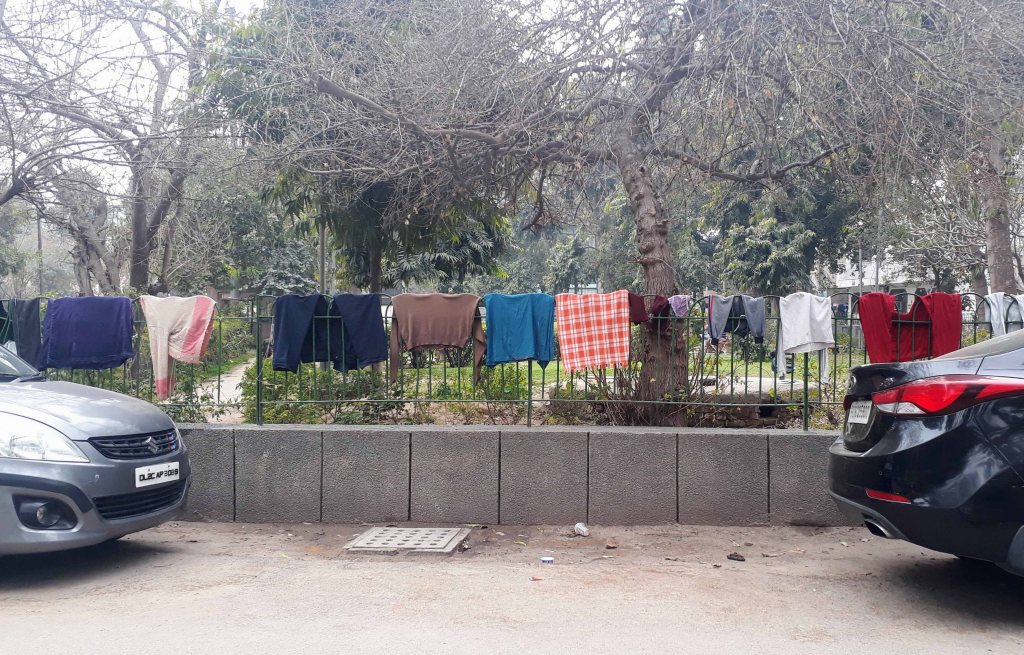
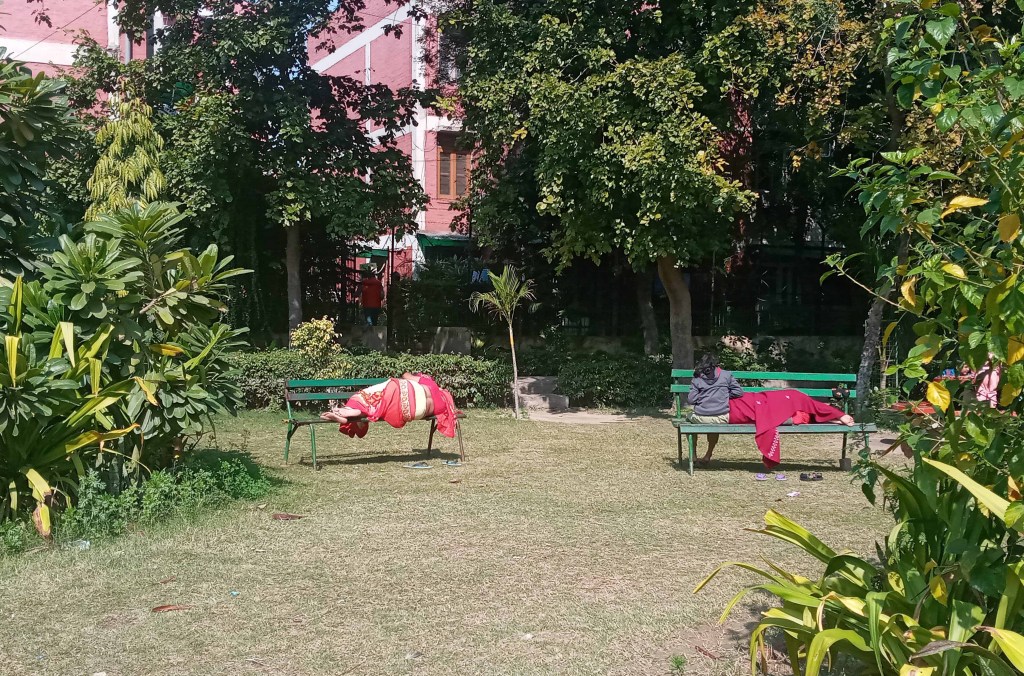
In Mumbai, my winter clothes have remained packed inside the box bed for a year now. I open my kitchen window, stick my head out, and breathe in the morning air—cool, quiet, with generous sprinklings of the fine dust of construction and destruction I am surrounded by. At the same time, I breathe in another February air, cooler and crisper, pungent, but holding the hazy promise of a clear day, a walk in the neighbourhood park, lunch on a chatai on the terrace, or a spontaneous visit to Lodhi Gardens. I am here. I am also there.
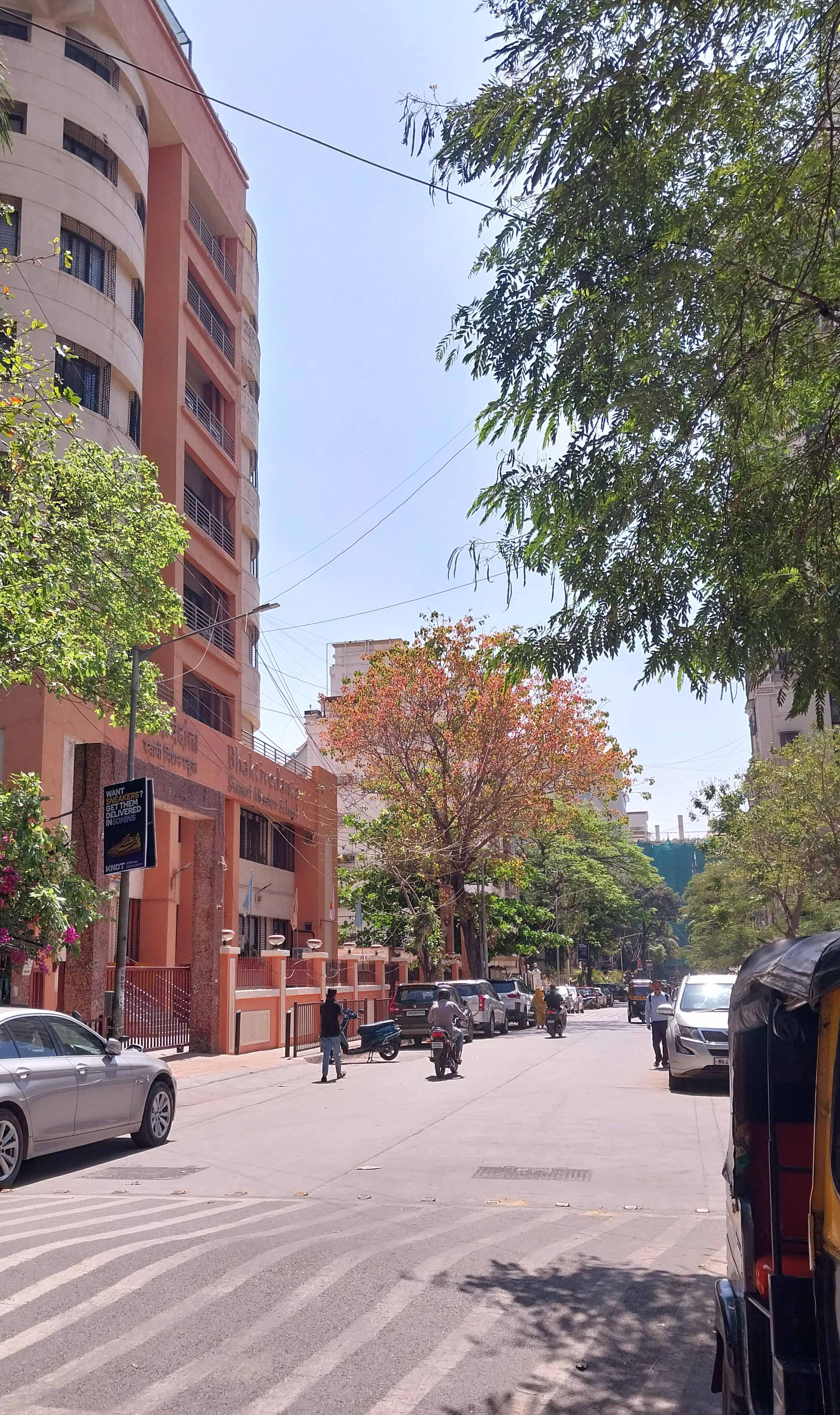
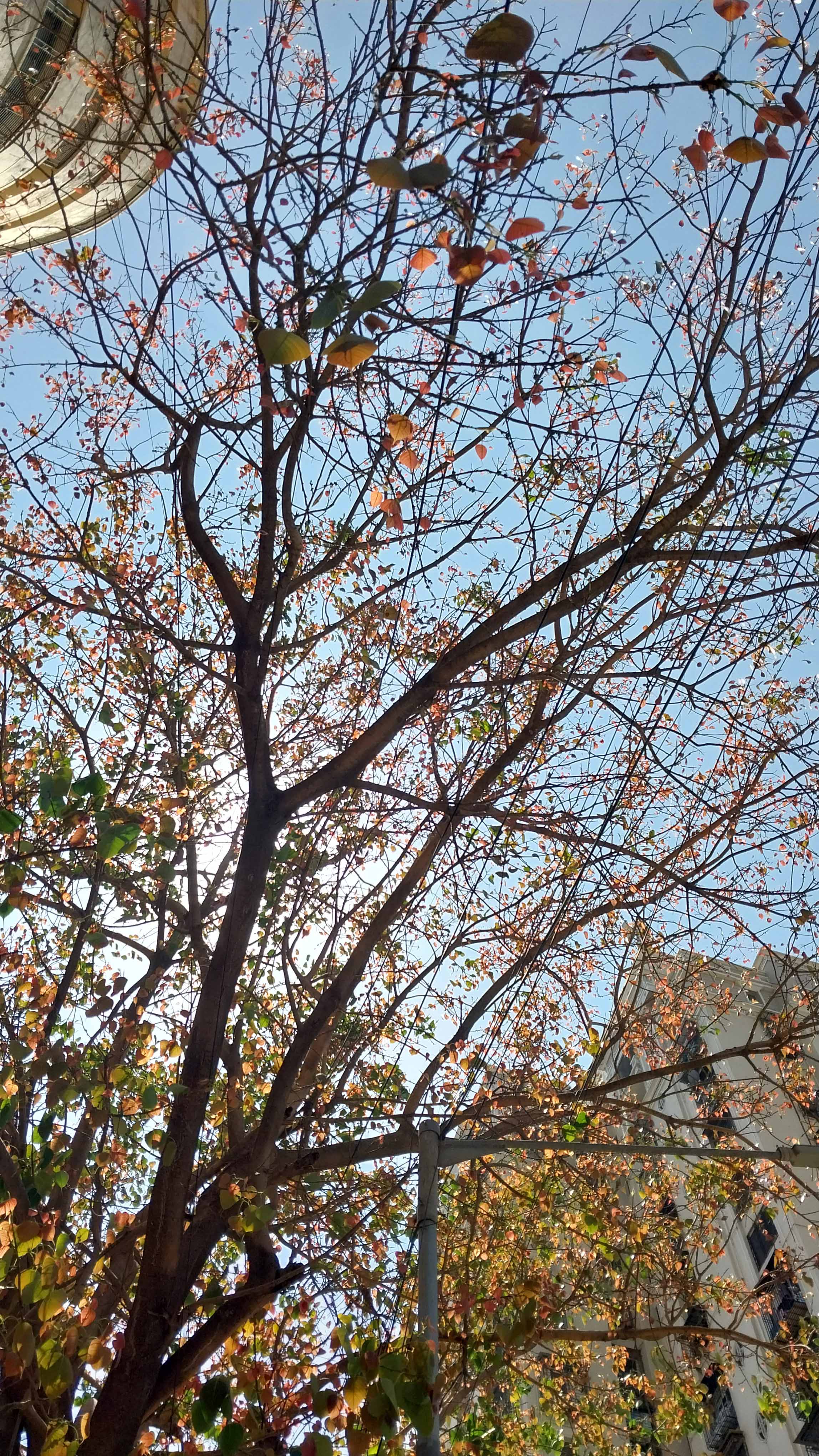
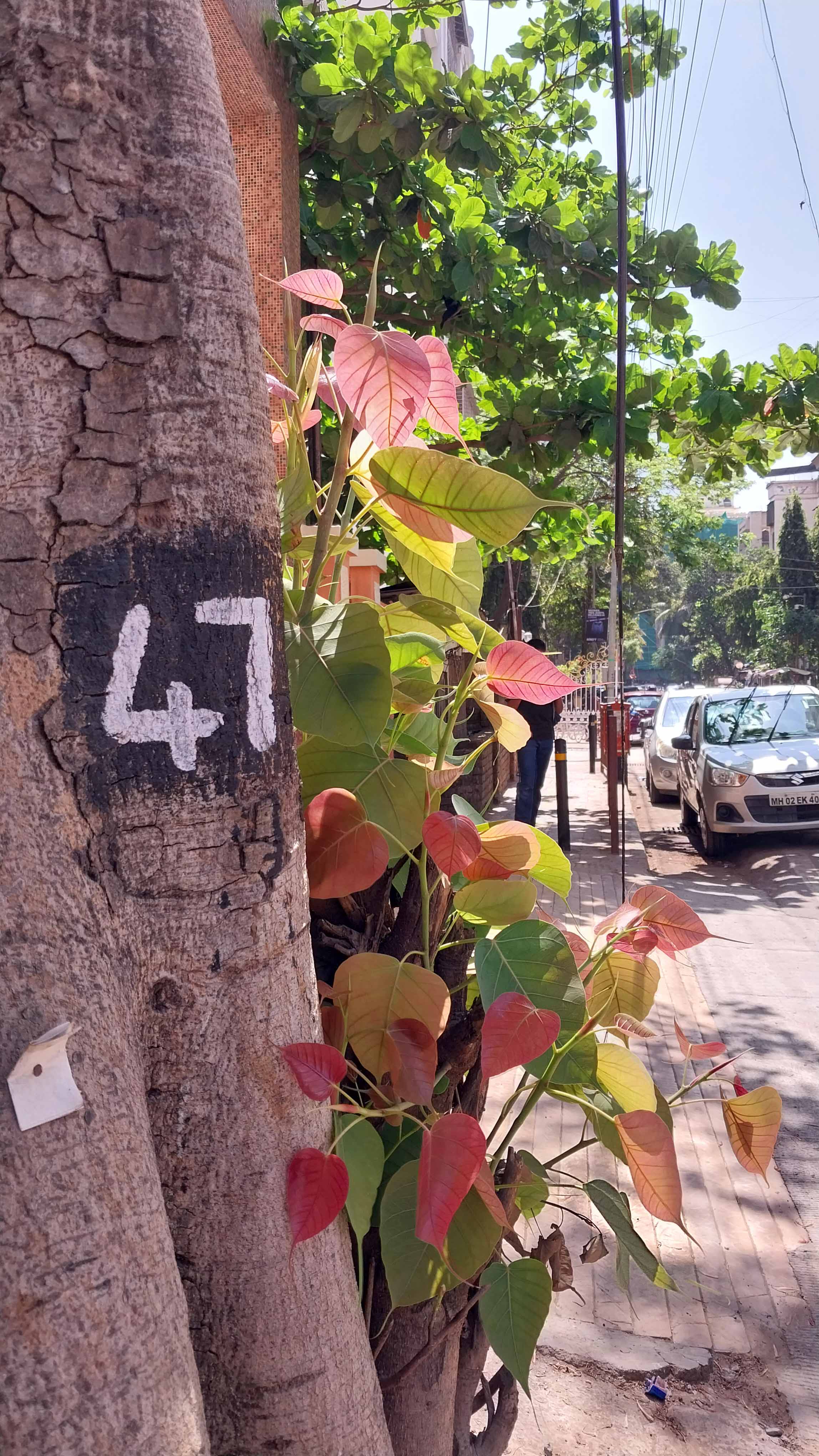
Pink peepul in March, Mumbai.
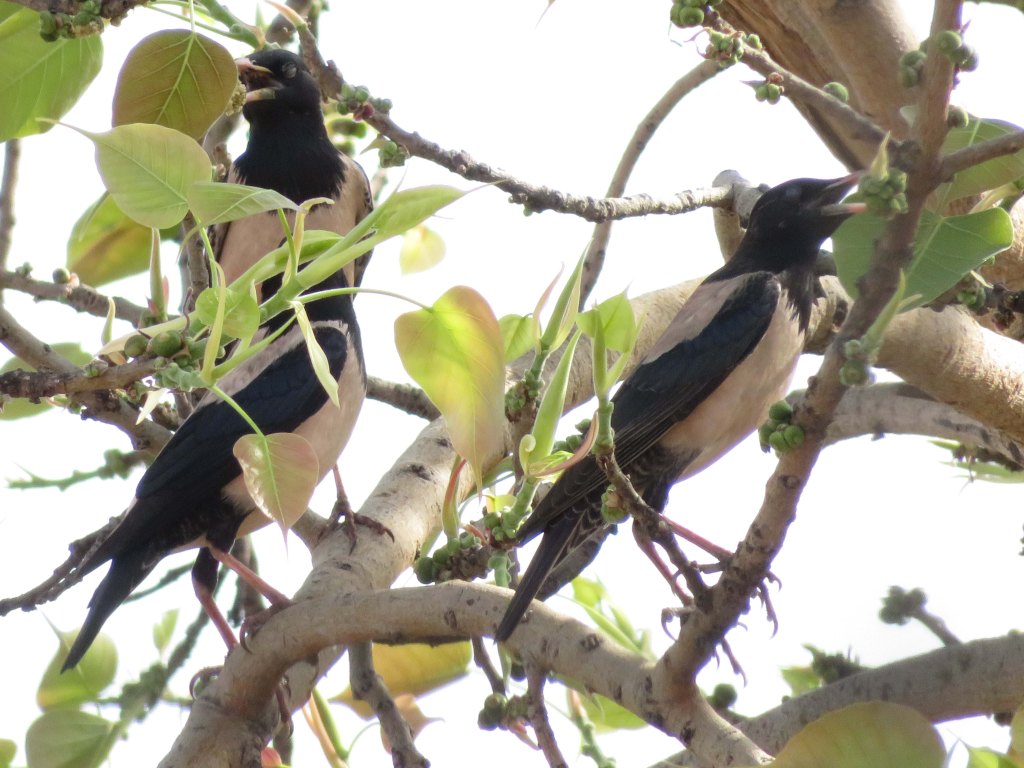
In March, I watch over the peepul tree from the windows of the study in my Mumbai house. It has new shiny leaves. Pink leaves. And I am standing in another house, this time on a tiny balcony, from where my hand can almost reach out to a branch of the peepul tree across. It is March on the balcony too. The leaves of the tree are also new and shiny. And pink. Flitting between the pink leaves are movements of pink, noisy and high-pitched. Rosy Starlings. Gulabi mynas. Hundreds of them. They have migrated to Delhi all the way from Eastern Europe and Central Asia. I can hear them here. I know they are there. Pink birds amidst pink leaves, making a tree throb with life. They are not here. But they are also here.
I could be here or somewhere else, but my body clock seems to be synced with seasons of Delhi. I could be in Goa in October and smell the sickly, sweet flowers of the devil’s tree in Delhi. Sometimes what I smell is an anticipation of the arrival of that heady smell, like it’s around the corner. Sometimes, I smell its absence. And sometimes, I smell its presence, not outside of me on a street lined with these trees, but inside me, not as a memory but as a switch that has turned on, marking a change in season. Much like how in December, no matter where I am, I crave for gajar ka halwa from Mahalaxmi Sweets in Madhu Vihar, a craving that is not so much an actual desire as my body sending a signal that it is that time of the year, the time for the annual fix of gajar ka halwa.
I don’t always know what I miss and what I long for. But I know I’m always in two places. The here, a place I have chosen to make a home and life in. The there, the place I loved and chose to leave. The here, my body, with its repository of smells, sounds, colours, tastes, the textures of the ground beneath me, the languages of the street, which I carry from where I’m not. The there, where my body is, engulfed by other sensations and feelings, often unfamiliar and disorienting, sometimes cruel, calling to attention or waiting to be discerned, making their way into my body but not settling down yet.
~
I didn’t set out to write about Delhi or the places I am not in and carry with me. Nor about love for a city or falling in love with a city. I don’t want to dissect what makes it possible. There is nothing heroic about loving a place—love can be oppressive, love can be demanding, it can make you lose bits of yourself as you hold up its myth, and it almost always is also made of loathing, despair, heartbreak. I instead want to think of what not-loving opens up—as a mode of being, thinking, feeling, and, even engaging with a place. Can discomfort and detachment—detachment not as a practised intentional stance but as simply the inability to form an attachment to or not-quite belong in a place—also be a way of seeing? A way of seeing that does not necessarily have to be made of disdain and indifference for the unfamiliar but one that is calibrated by curiosity, uncertainty, and the lightness of not-quite-knowing.
Learning to walk, walking to learn
‘How important it is to walk along, not in haste but slowly, looking at everything and calling out Yes! No! … To pay attention, this is our endless and proper work.’
―‘Yes! No!’, Mary Oliver
‘Walk carefully,’ someone had advised me, years ago, when I had just started fieldwork in Delhi’s bazaars. It wasn’t meant as a warning to a woman walking in the streets but a gentle nudge towards paying attention to the milieu I was walking in, in particular the materiality of the bazaar. It is an advice I’ve always held close. Here, in this ‘new’ city, ‘walk carefully’ is a siren playing in my head, making me cautious and clumsy at the same time. I can’t assess the speed of different vehicles passing by, they are either too slow or too fast. I seem to stop myself to let a vehicle pass just when it seems to have slowed down for me. And every time I think I have ample time to make a dash across a road, I just about avoid being crushed by a vehicle that appears speeding out of nowhere. When I’m extra watchful of vehicles, it is difficult to simultaneously dodge the diverse forms of dog shit and construction rubble that line the footpaths and edges of roads. Then there are the cracks and crevices to avoid and the undulating surfaces of footpath pavers and of concrete roads to negotiate. And if I resolutely train my eyes on ground level, it seems to give cars and two-wheelers the permission to dangerously graze past me without warning. I haven’t honed the grace that comes from walking the same neighbourhood and paths repeatedly. I may not ever. There is no ‘intricate sidewalk ballet’11 that I am part of—it is a sprint for daily survival, like much else in this city. Yet, sometimes, I take a chance and pause to admire a scattering of leaves or flowers on the ground, and look upwards to see which tree they’ve come from, quickly making a note of the characteristics of the tree, so I can look it up later at home.
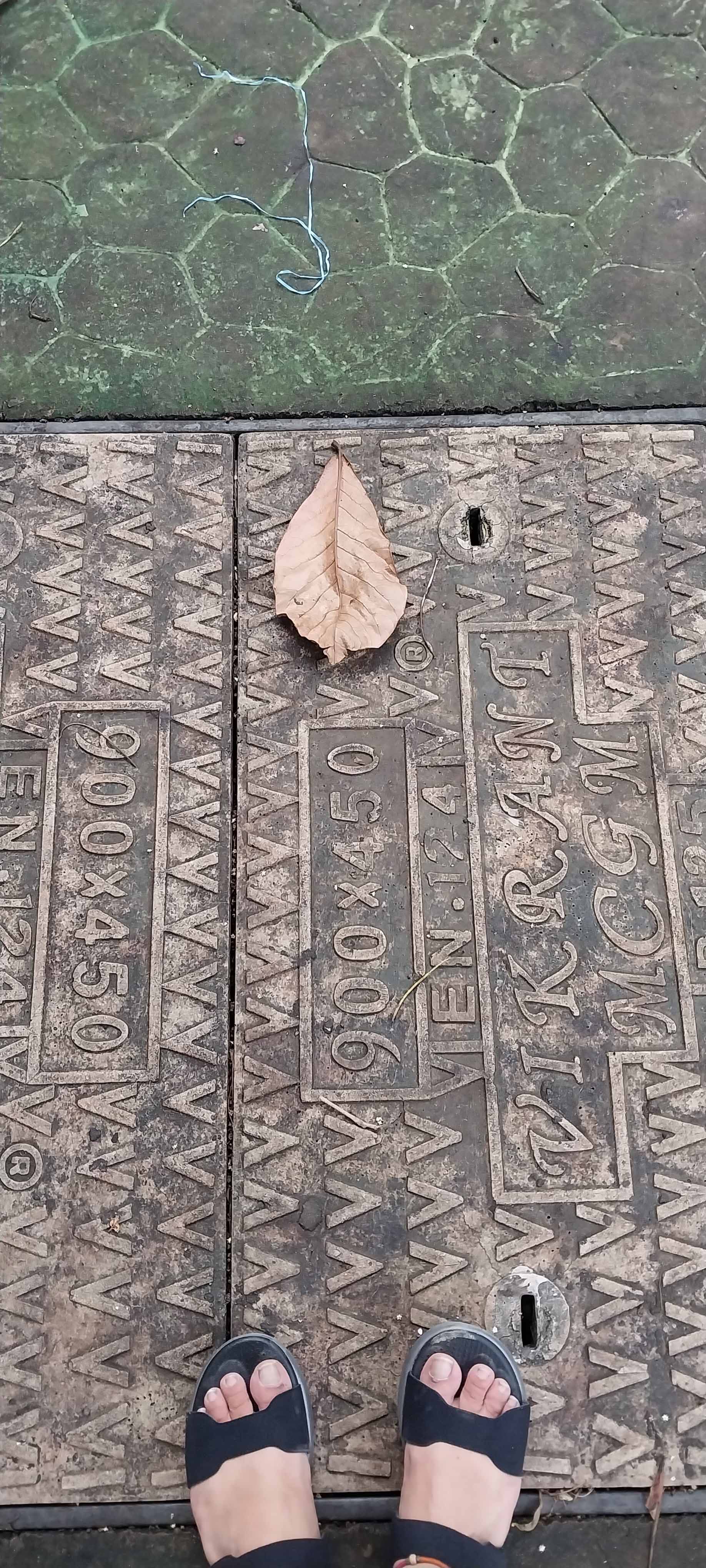
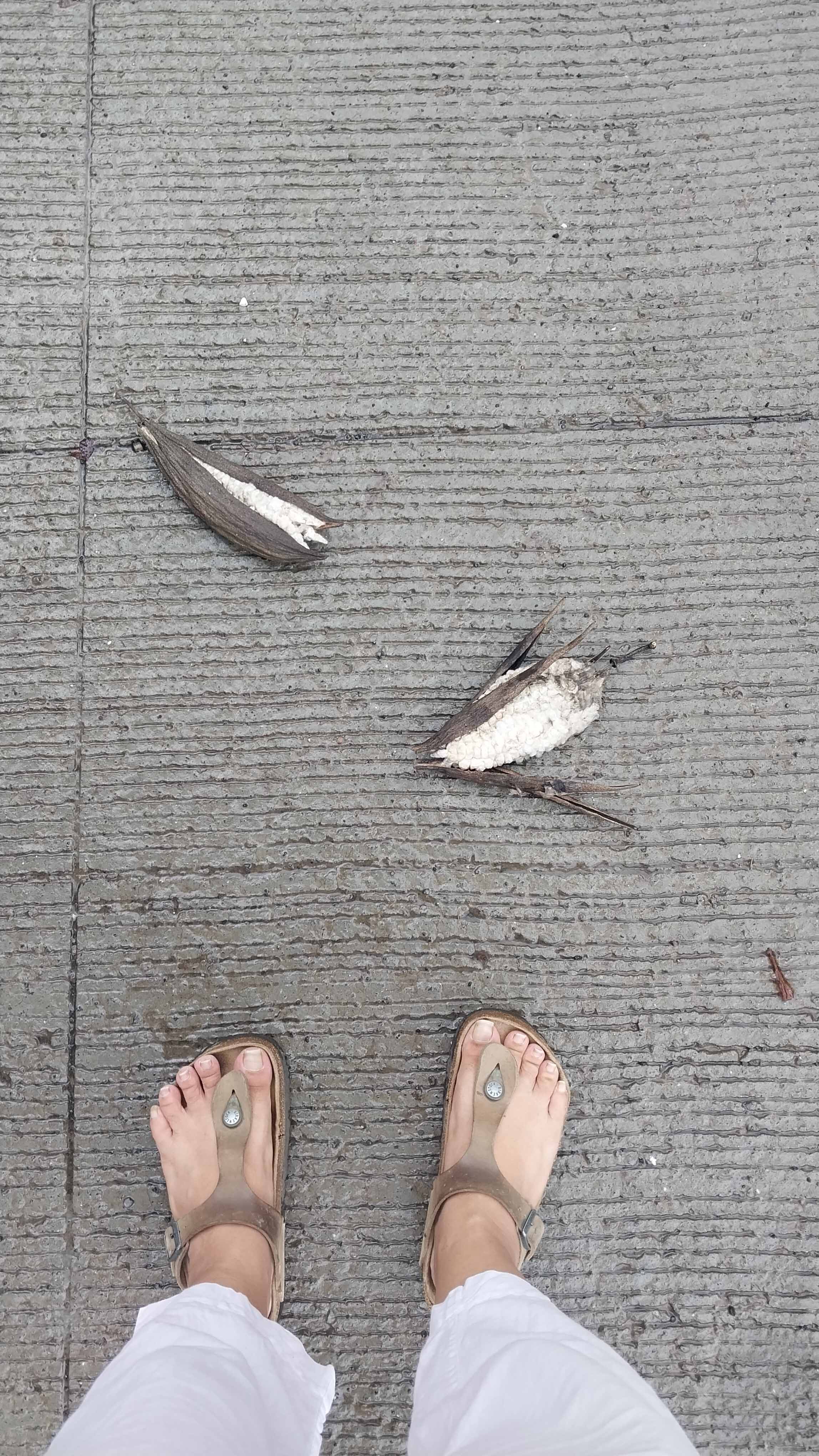
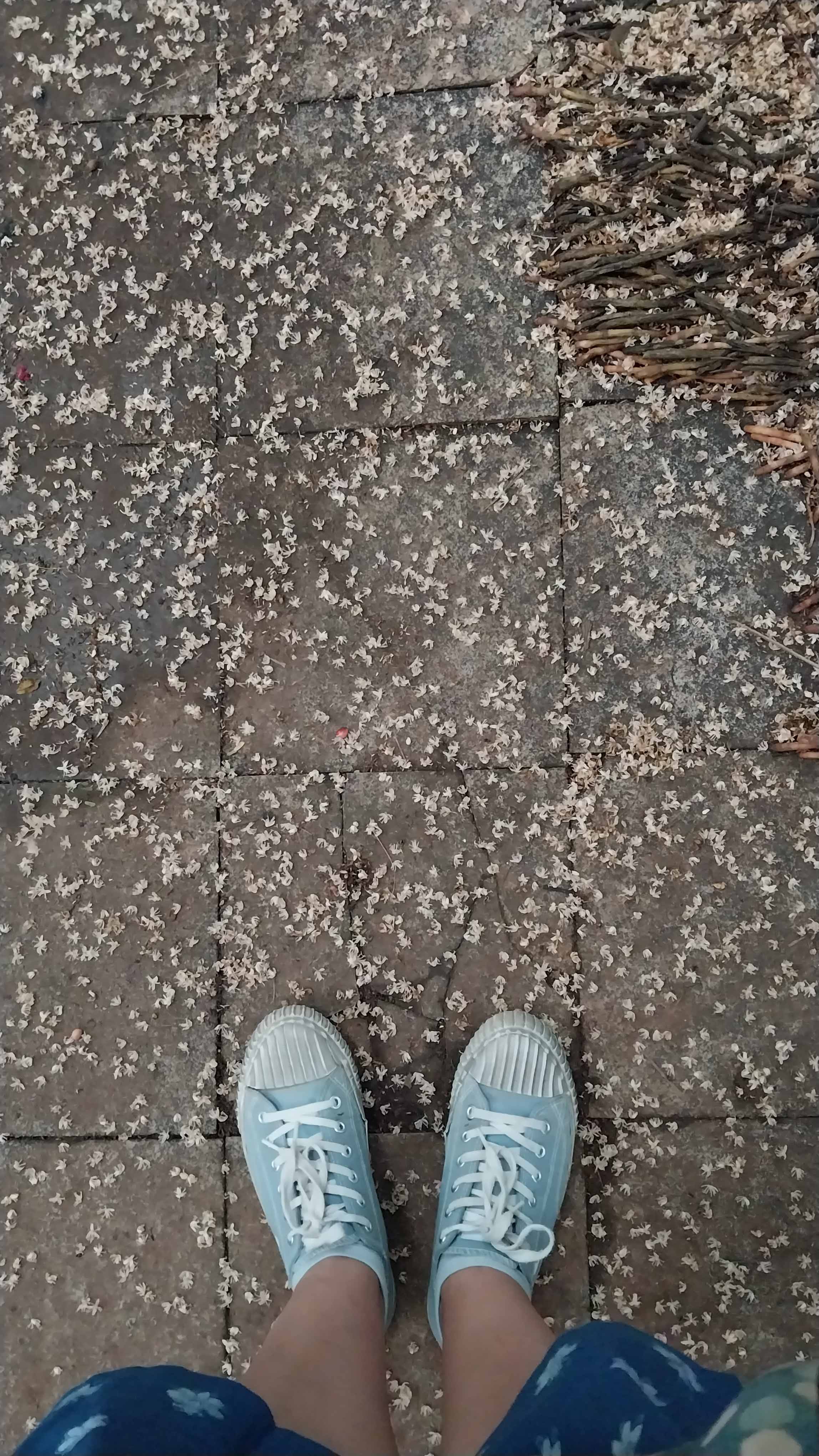
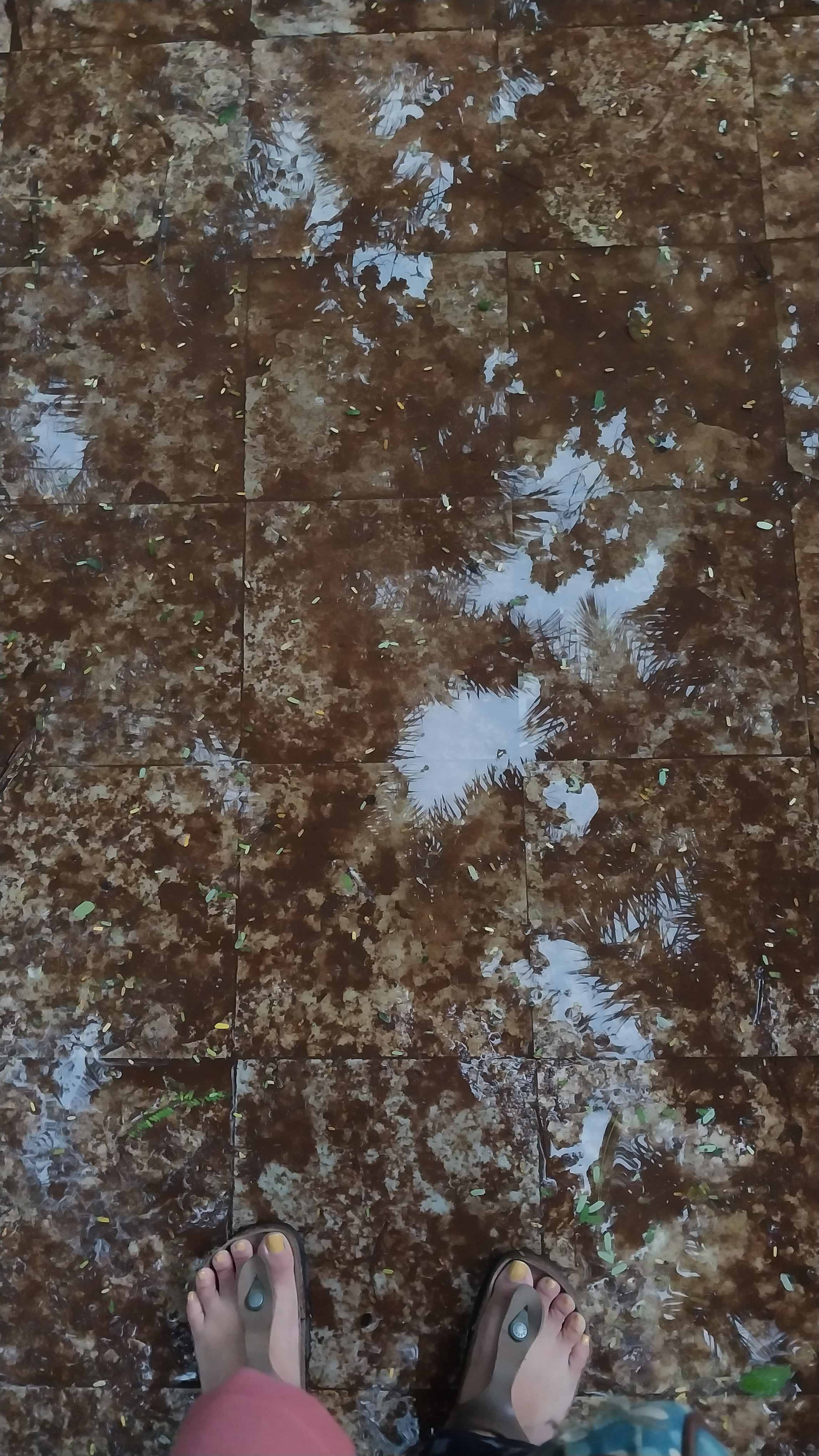
Learning to walk, learning to pause.
Notwithstanding the assault on the senses and the dare-devilry involved, I make my way through the anarchy of the traffic (it begins right outside my apartment gate) every day to get to know my neighbourhood (the third in Mumbai over the period of a year), one hesitant step at a time. I walk to shop for groceries, fresh produce, and flowers, or to get something repaired—a habit of decades I can’t get rid of. Every once in a while, I also walk to this lovely bookshop, sometimes for a quick visit, knowing exactly what I need to pick up, and sometimes for a more leisurely browsing.
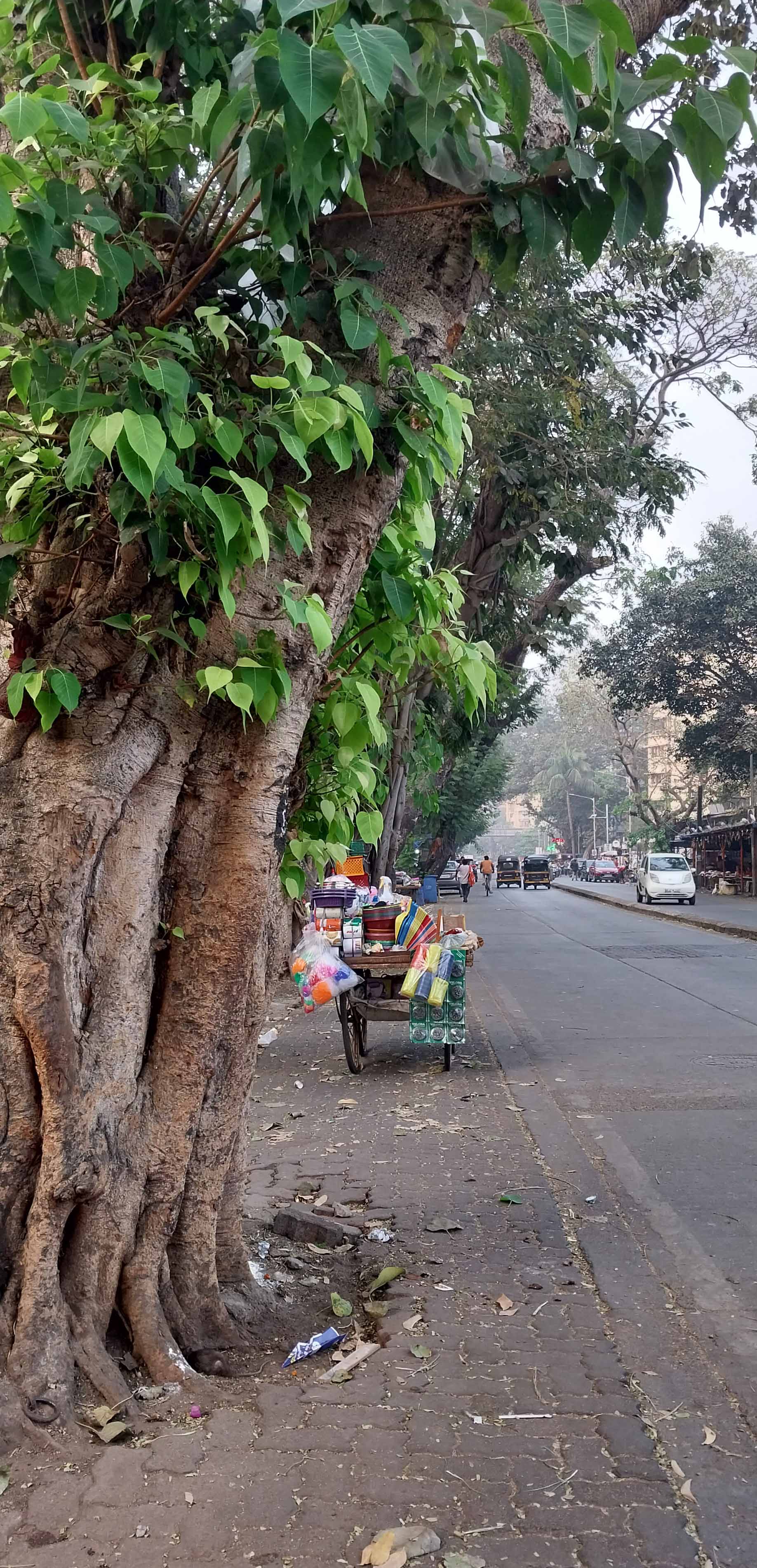
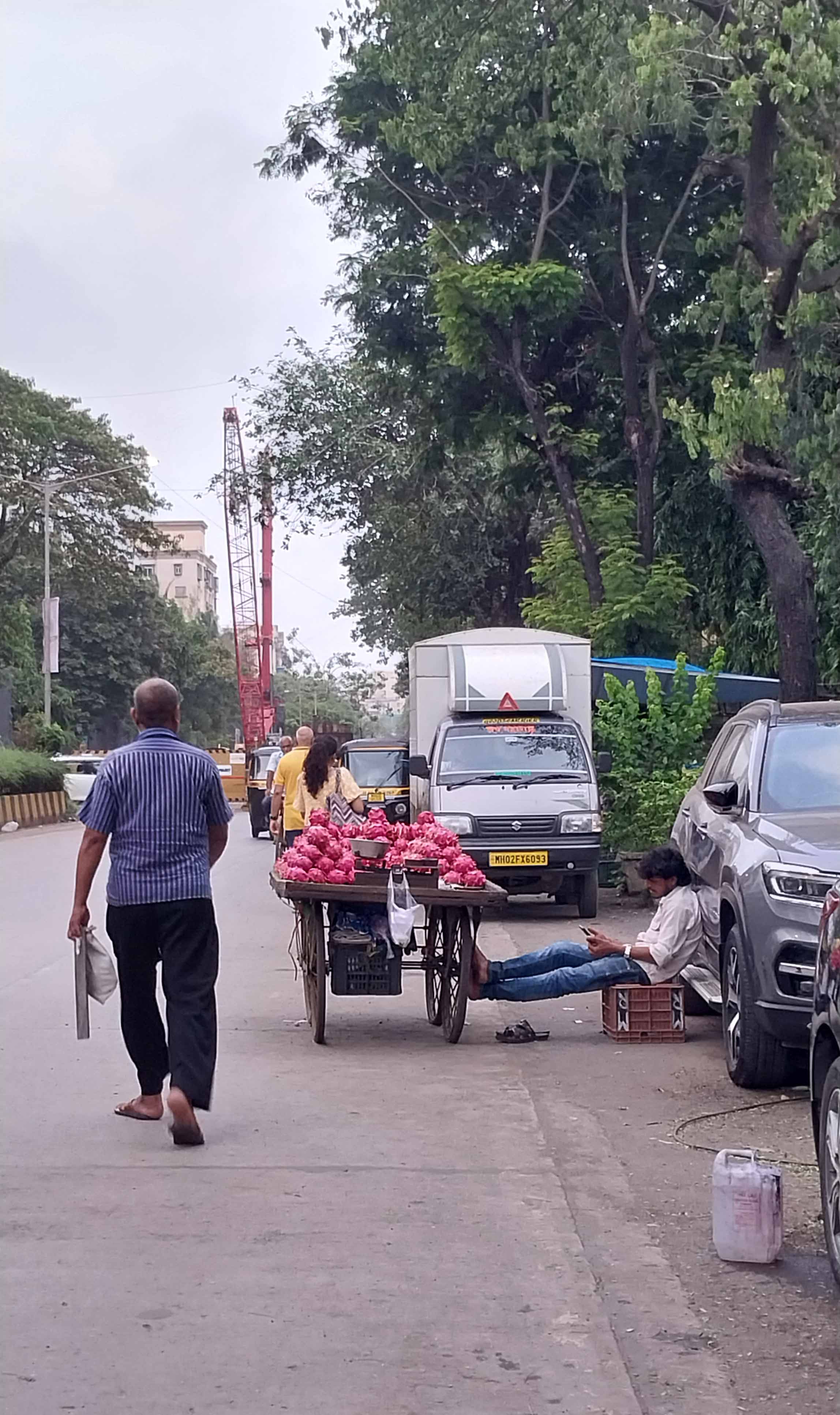
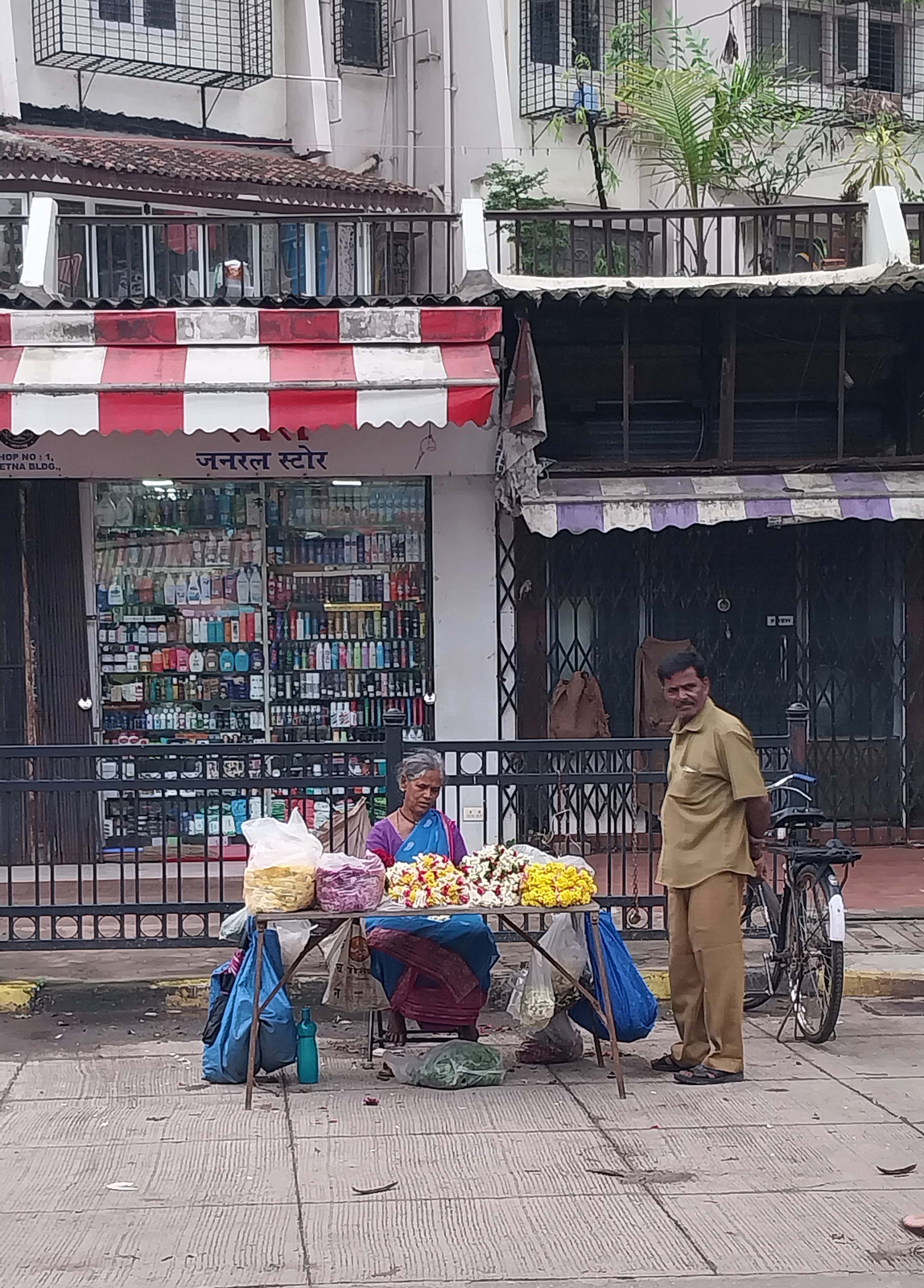
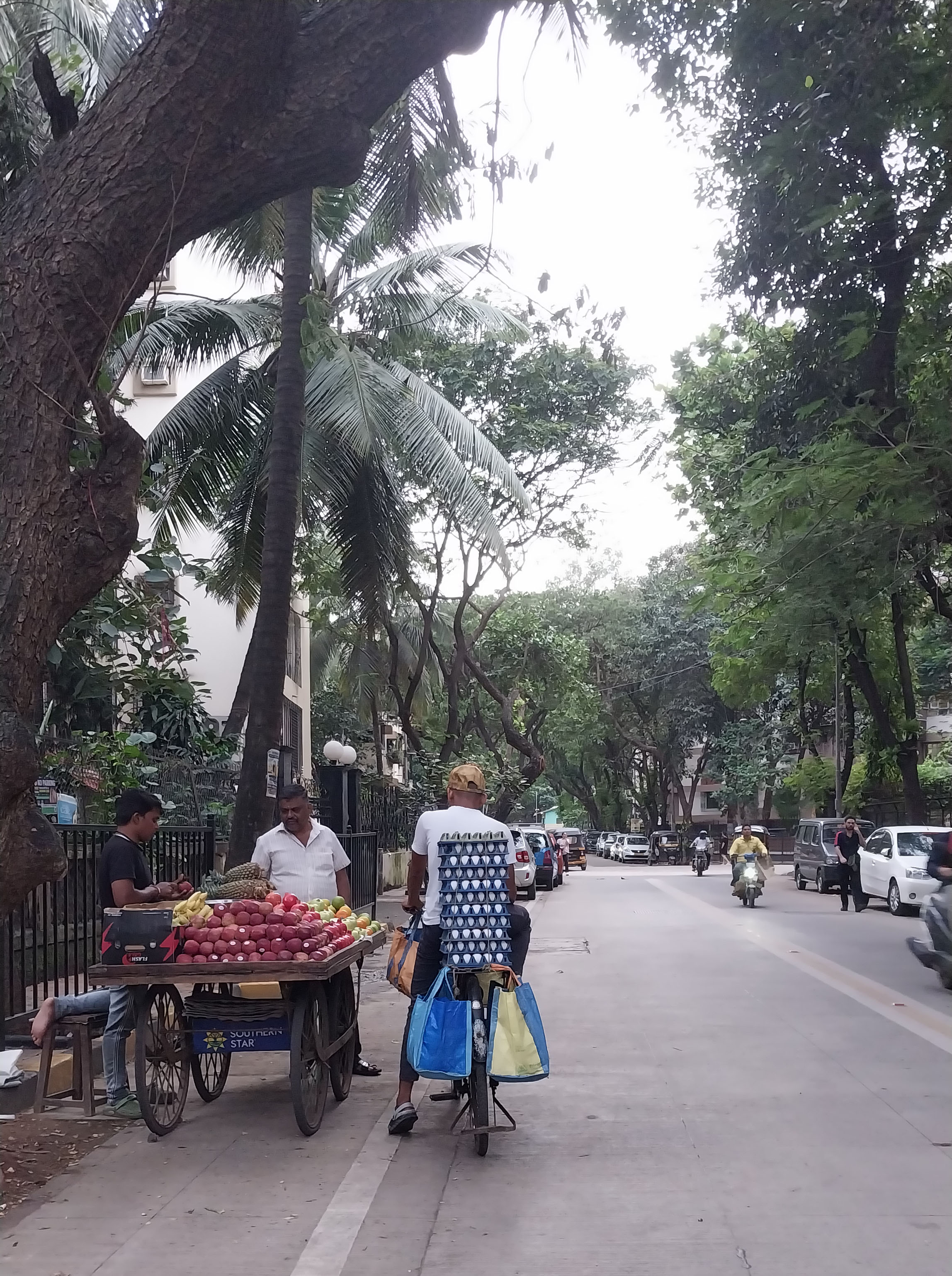
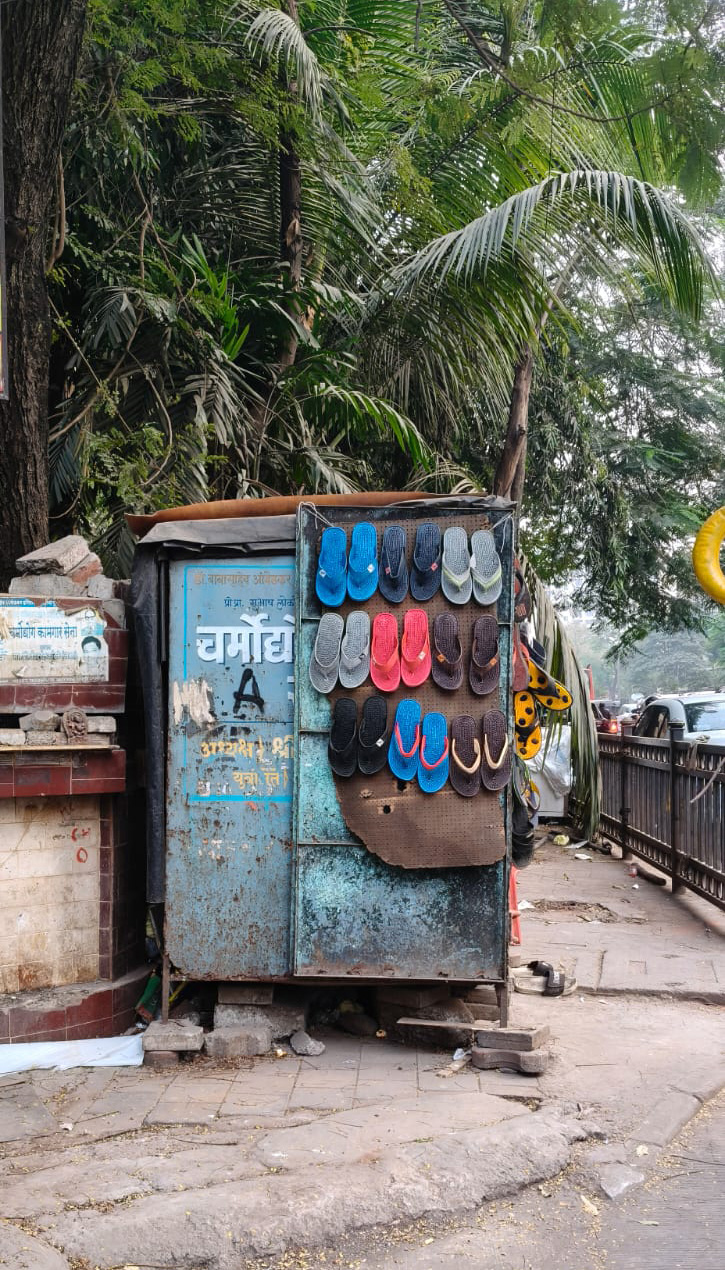
Street shops in neighbourhoods I’ve lived in, Mumbai.
And then I step out again in the evening to reach a tiny (or maybe not, by Mumbai standards), slightly unkempt park, with a playground in the middle, lined with trees, and an uneven walking track around the ground. The track is punctuated by benches and the branches of trees trespassing into the park from the street outside and the adjoining buildings, strewing the walking path with their flowers and leaves. On one side of the park is a small cordoned-off area, with a cluster of much-in-demand dilapidated swings, on one side, and a set of exercise equipment that has seen better times, on the other, used only once in a while for exercising and sometimes by kids to romp around.
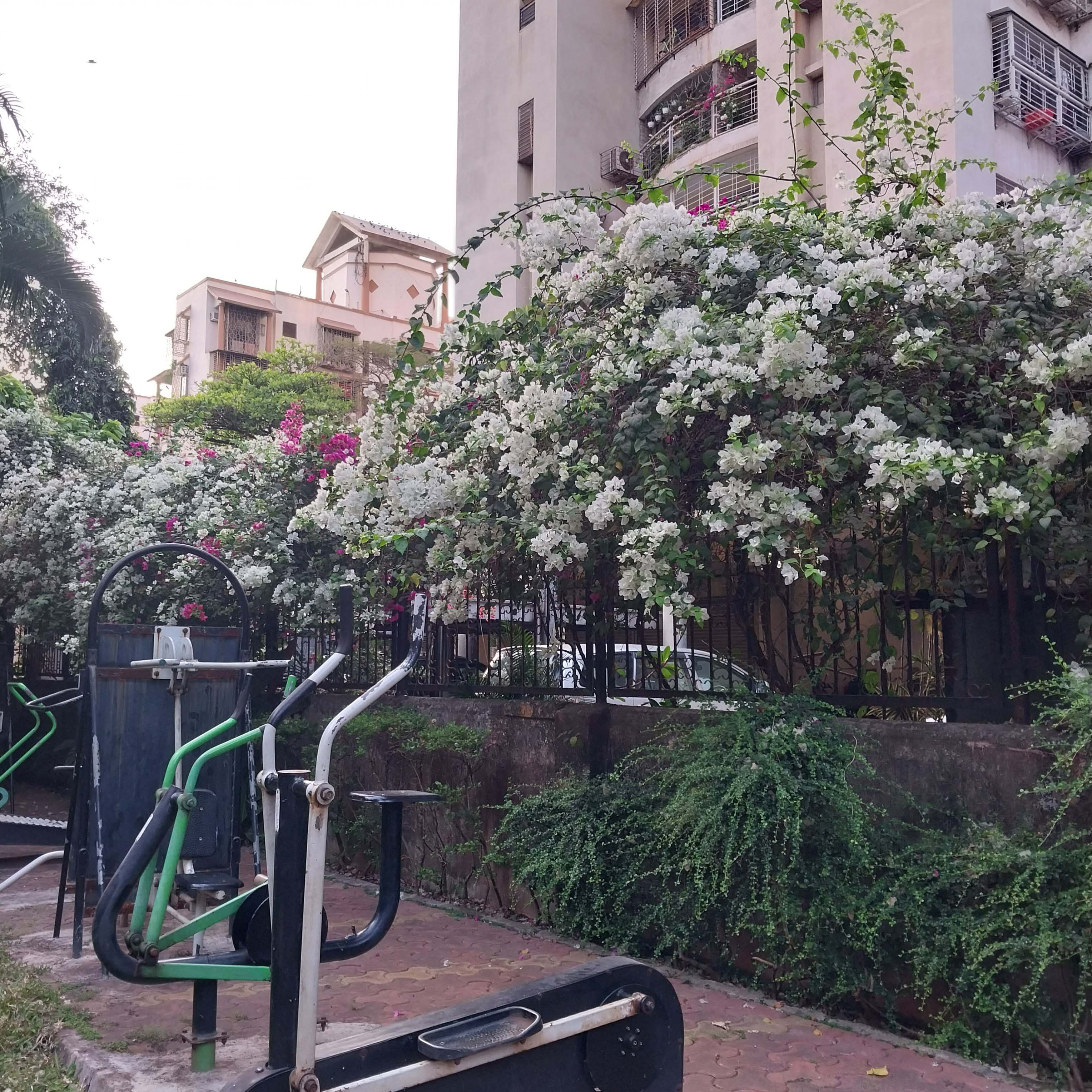
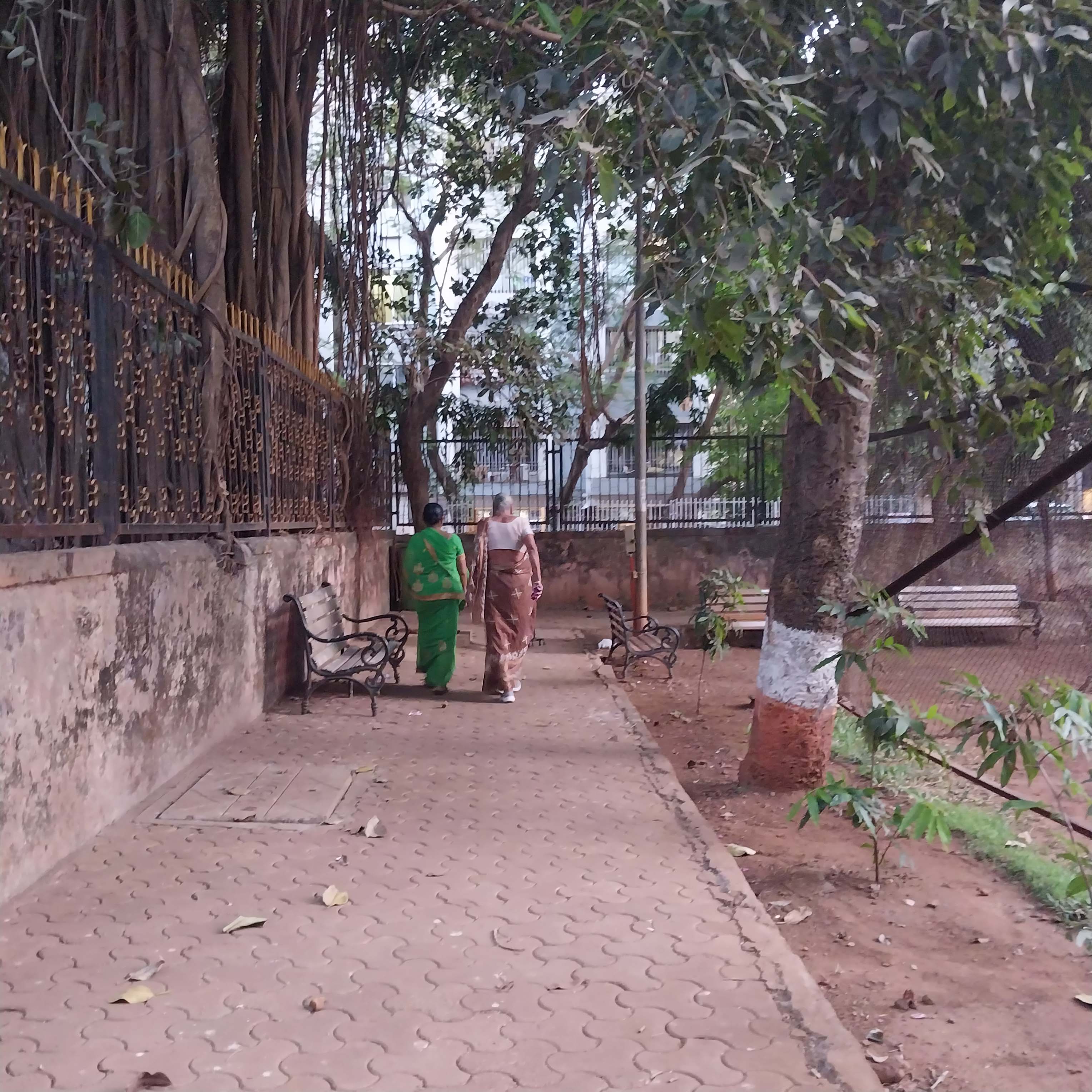
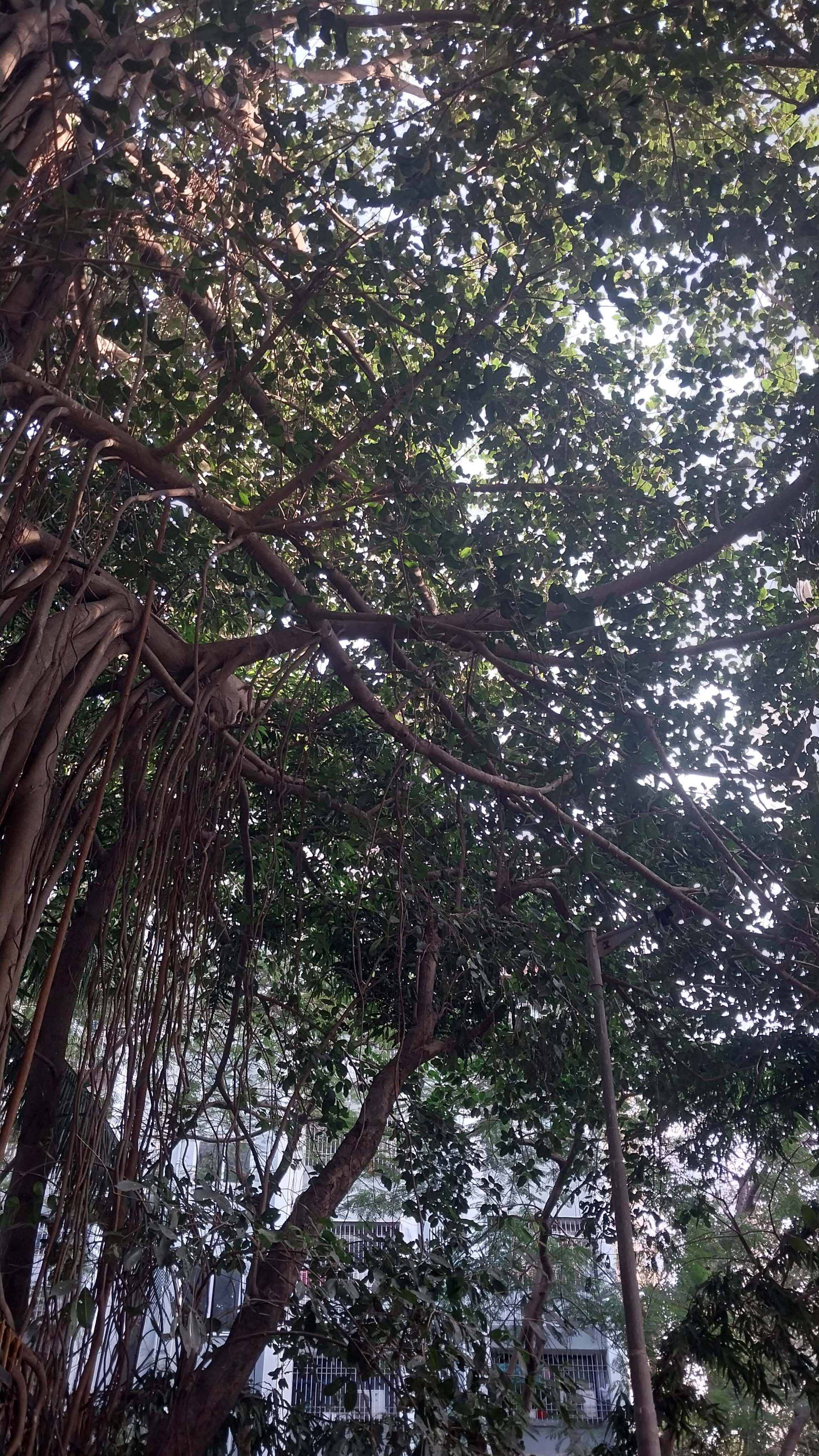
Clockwise from top: The exercise area in the park, a gigantic banyan spilling over into the park from an adjacent building, the walking track.
Over the last couple of months, it is in this nondescript park that I have come to seek momentary respite from the concrete and glass edifices, existing and in various stages of assembly, of the neighourhood I live in. I have come to slowly identify the fixtures and regulars of the park: The resident tomcat, usually sleeping at the entrance or the bench near the entrance of the park, the grey cat, sometimes curled up like a ball under a palm tree and at other times prowling on the edges of the park, the battle-worn tom cat sneaking up the wall of the park, and a host of visiting cats that drop by now and then for a special appearance. The jhula enthusiasts including ‘Jhulelal’, a young wiry man who swings at a dizzying speed, sitting cross-legged, all the while fiddling with his phone and sometimes singing. The bunch of sales people, some catching a nap, others gossiping about a colleague or the boss. The waiters from the adjoining cafes and restaurants, resting, catching a quick meal, watching reels, or talking to a lover. The dazed stoner. The huddled-up lovers, talking, watching their phones together, sulking, or squabbling. ‘Anticlockwise Uncle’, who walks the longest and is the only one in the park walking anticlockwise. The different groups of cricket players, whose clothes and shoes set them apart in different cliques, each playing till it gets dark or till the ball has disappeared and can’t be found. The old caretaker with a limp, who is usually sits or sleeps next to the resident tom cat and sometimes drags himself to clear the park of dried palm leaves. The guard from the apartment opposite the park who sits on a bench with a vacant look and always his shoes off, and sometimes walks, shuffling barefoot along the edge of the walking track.
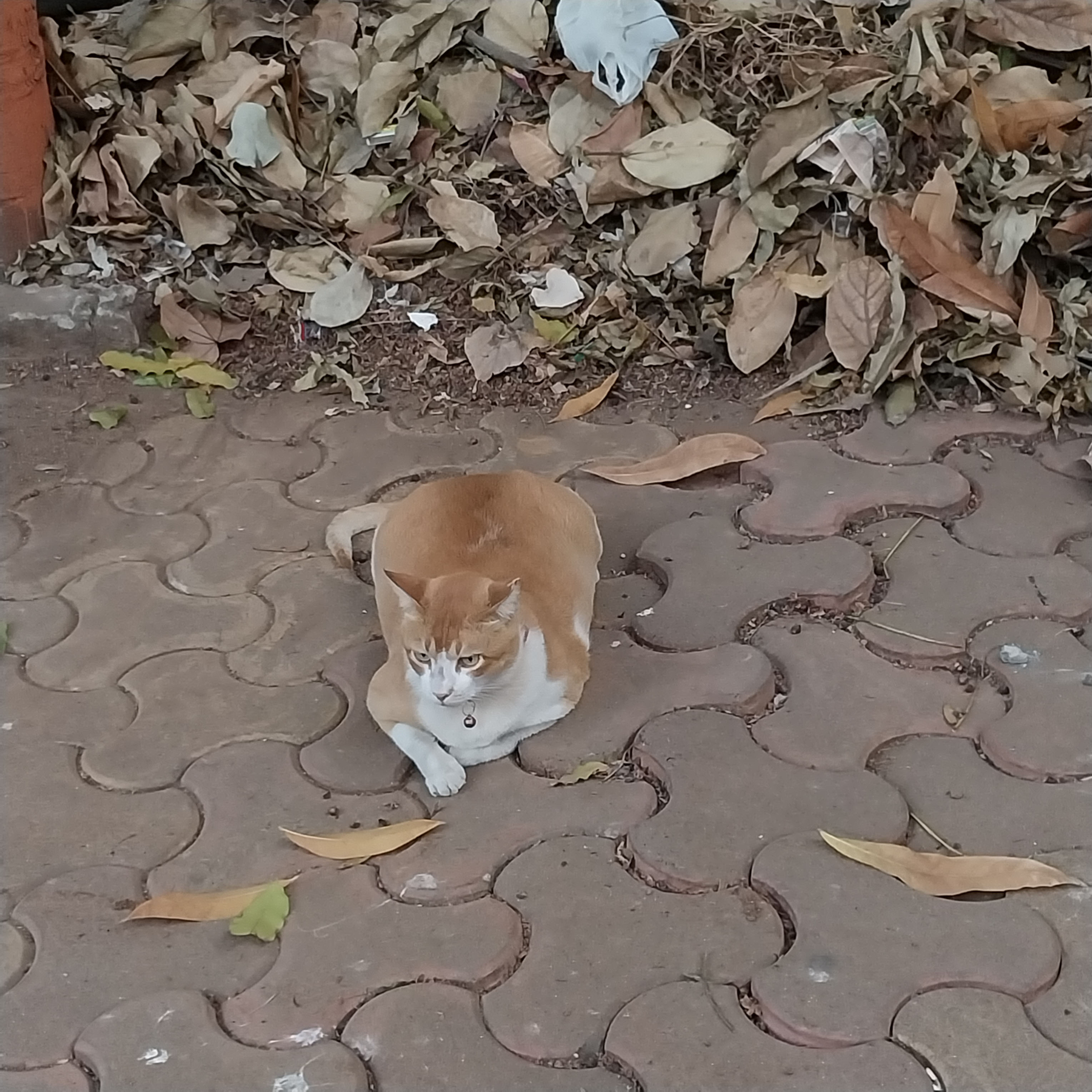
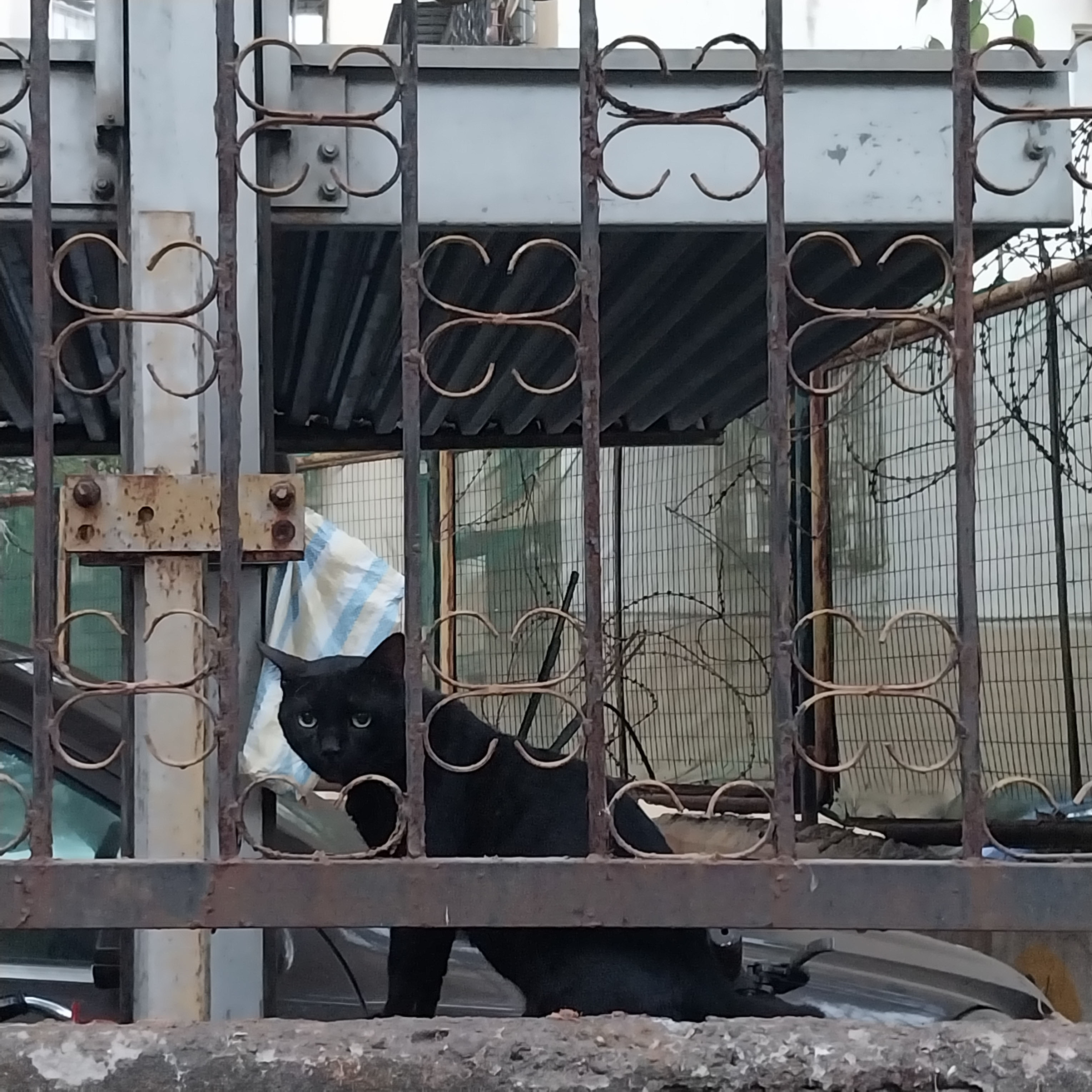
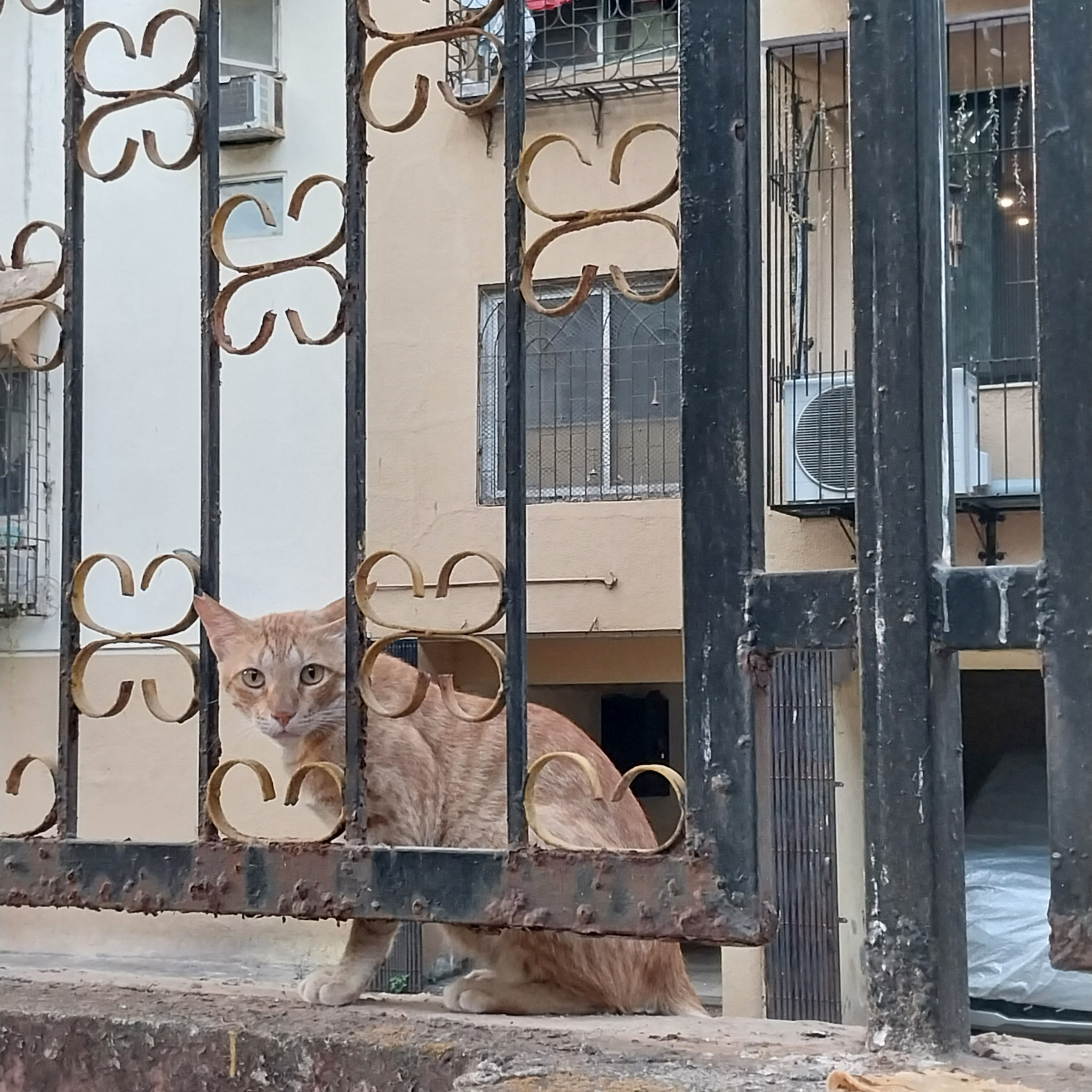
Cats of my neighbourhood park, resident and visiting.
The park seems to have a different rhythm from the street and world outside—a break in the continuous hustling and hecticness the city is enfolded in. I step inside and it somehow doesn’t matter that is not particularly spacious or not particularly beautiful. And the minute I step outside it, I’m caught up in the struggle to move with and against the rush of the city, anxious to quickly get home. But I’m grateful for its existence, for holding space for me, and so many others, in a city that seems to be on a war to annihilate open spaces and trees.
Birds that visit, trees that stand
‘in times like these
to have you listen at all, it’s necessary
to talk about trees.’
—‘What Kind of Times Are These’, Adrienne Rich
When I moved to the house I currently live in last December, while I was happy that I had more (window-ledge) space for my plants, I thought I would no longer have small birds visiting me like before, given that I was moving to a more densely built-up neighbourhood, with fewer trees and fewer parks. The first month, when I would look at the two large trees facing the living room, I would see only crows, lots and lots of crows. They would create a ruckus early morning, and then through the day, often competing with the blaring of a car alarm, which would go on for hours, often exactly at the time when I needed to concentrate on some work. They would get even louder at dusk, and sometimes wake me up in the middle of the night. They probably do it because of the bright lights and noise created by humans at night, but I’m superstitious about crows cawing in the middle of the night. I feel they are the harbinger of bad news. And we could all do with less bad news!
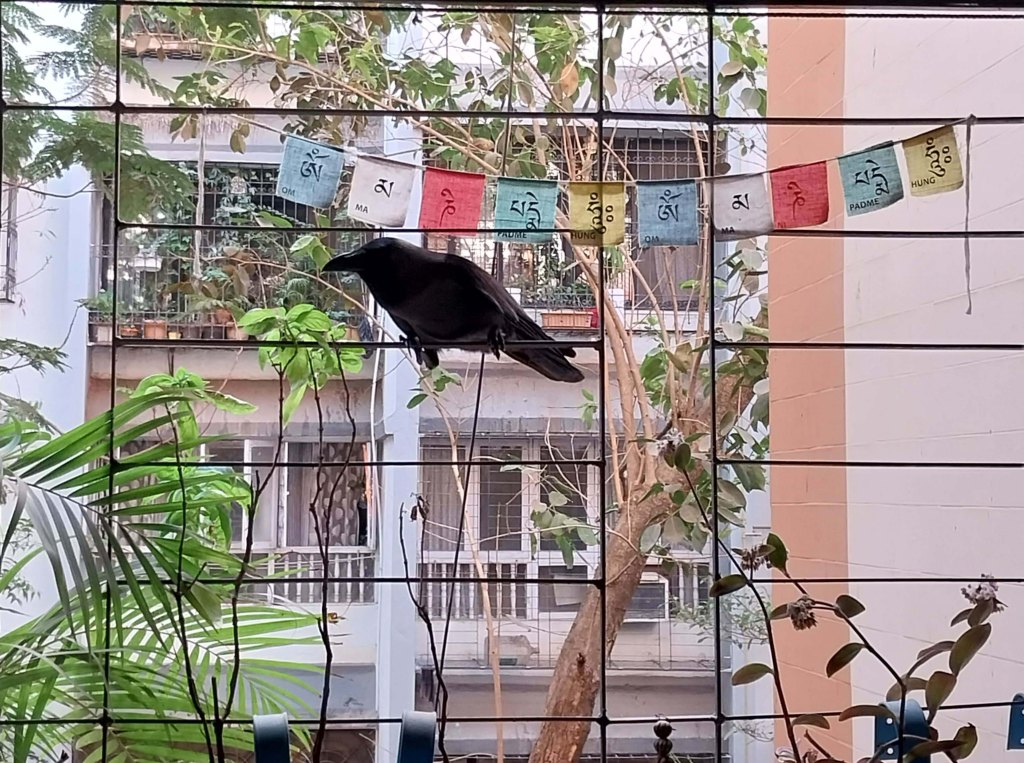
A month or so after I moved, one morning as I was handing my partner a ceramic blue bird to hang from the bedroom window, I heard a familiar, soft yet shrill, cheew-ing sound from the window of the room across. I ran to the other room to find a purple sunbird pair flitting around the hibiscus flowers, pausing every now and then to peep into the room. It seemed like the pair from the my previous house had come to visit us. The wonder I felt is not something I can put into words. It felt like magic. And I thought that yes, this city will do for now, and maybe I will survive this city. The next day at exactly the same time, the pair was back. And it was followed in quick succession by a bunch of sparrows, then some red-vented bulbuls, and a lone myna. They all chirped loudly, as if saying, ‘Yes, we are still around, and we’ve just come to say hello!’ I’ve never felt as welcomed to this city—the ways of which I’m trying to learn and might never do—as I did at that particular moment when this assortment of small birds descended on my window and twittered noisily, facing towards the inside of my room. They left as quickly as they’d arrived, and never have they ever all come together on that window sill. The purple sunbird pair comes every day though, always at the same time, and always to flit around the hibiscus plant. And amidst the dominating presence and noise of the crows, I am slowly learning to notice other presences—a coppersmith barbet, a white-throated fantail, magpie robins, parakeets, a brown rock chat, and others.
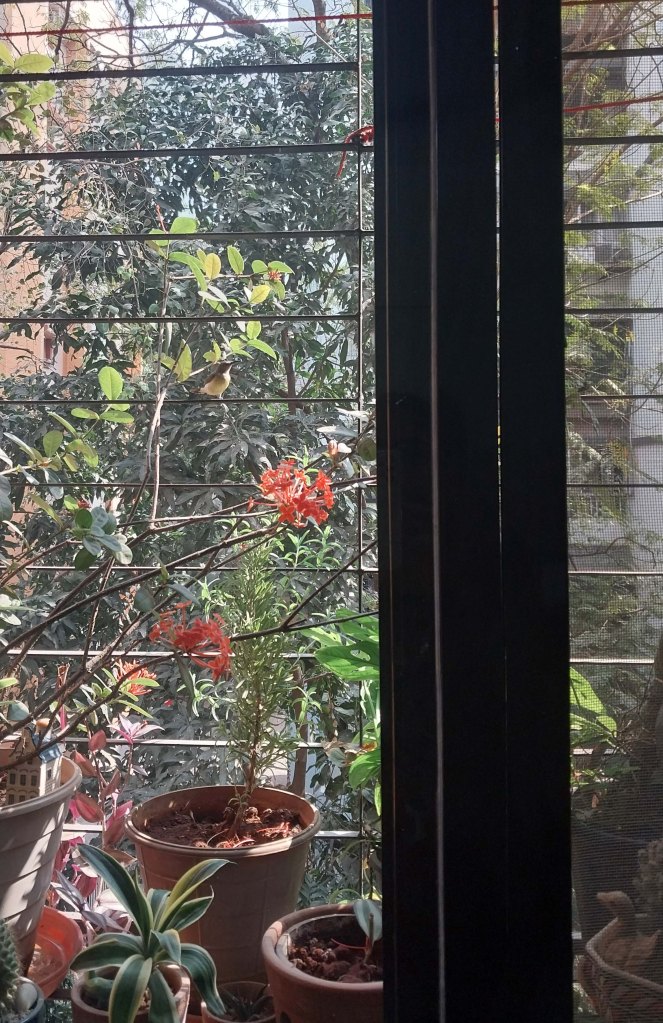
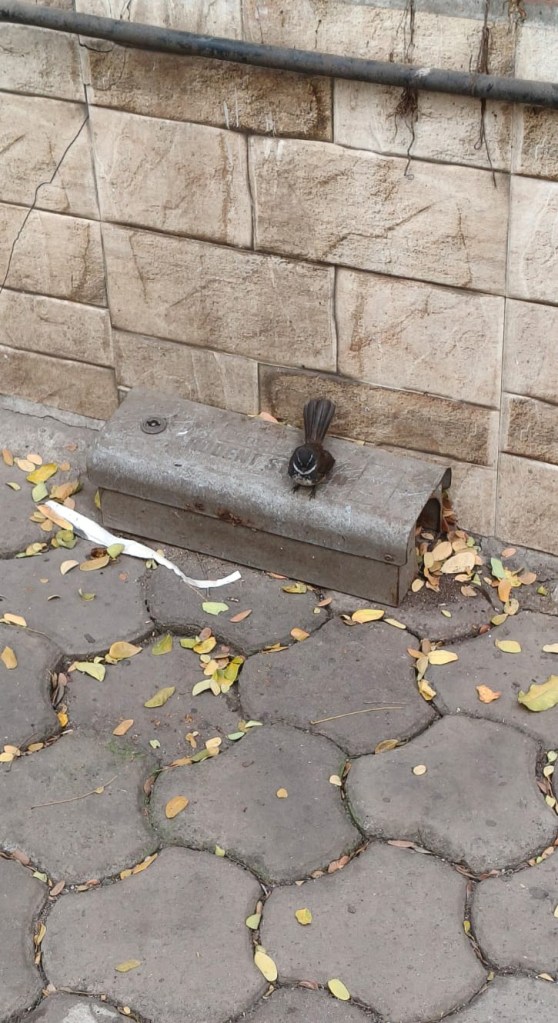
Left: The female of the purple sunbird pair that visits us. Right: White-throated fantail in my apartment complex.
On a morning that I was missing my father so much that I was finding it difficult to breathe, I sat on a mooda in the living room, my face turned towards the partial view of the peepul tree that is in the adjoining apartment complex. As I practised deep breaths, fat tears started rolling down my cheeks. In a few minutes, I noticed something yellow, not very small, in the peepul tree. I wiped my tears to get a better view, and then climbed on to the ledge against the windows. It was a male Indian golden oriole, a bird often difficult to spot because it is shy and hides in dense canopy. I had last seen one in Bhubaneswar in 2021, my first trip there after the pandemic, while walking in the neighbourhood my parents lived in. I stupidly moved away from the window to get my phone to capture this beauty, and by the time I was back at the window, the bird had disappeared. I was elated all day though, believing that the golden oriole had shown itself to me, at that particular moment, to cheer me up, making me aware of the beauty that exists even in the midst of loss and grief. Some days when I am finding it difficult to just get through the day, I think of that day when the assortment of birds came to my window and the day the golden oriole revealed itself to me, and I know I’m going to be okay.
~
In November last year, after a bruising day of house hunting, followed by a meltdown on the street, as I was walking aimlessly to shed the bad mood, I noticed a tree inside an apartment complex. It was very tall and broad, seemed somewhat out of place, something out of a fantasy book, more creature-like than tree-like, a little sinister, possibly because I’d never seen anything like it before, but mesmerising. It had large woody spherical fruits growing from its trunk, as also flowers. It also seemed to have magical powers because it certainly banished my bad mood. Later that day, scrolling through the scanned copy of Trees of Mumbai,22 I figured it was a cannon ball tree, a deciduous tree native to the rainforests of South America.
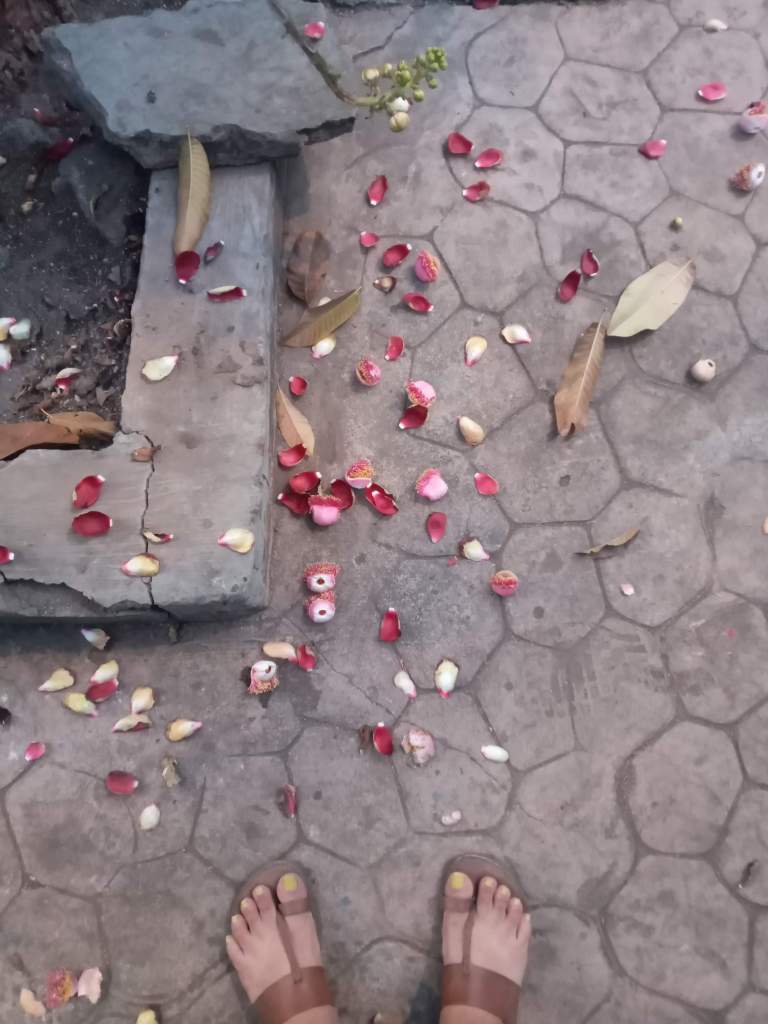
Do trees that have travelled to this city from faraway lands remember the weather, smells, creatures, and people of the places they have left to make home here? Were they disoriented to begin with? How do trees, the ones from elsewhere and the ones from here, manage to be resilient, exquisite, and generous in the midst of the continuous havoc of their urban setting? As I struggle to find my bearings in the city where everything seems to be getting obliterated and transformed into something else, where charming cooperative housing society buildings disappear suddenly, street shops fold up in the blink of an eye, perfect asphalt roads get brutally excavated overnight, I think of the trees of this city—the ones that call to attention due to their unfamiliarity and the ones that discreetly exist. For every tree that I already know and come to notice and every tree I’m not familiar with and ‘discover’, I feel a quiet joy, I feel my feet firmly on the ground, even if they may not be ready to grow roots here. The desi badam trees quietly mark the passage of my time in the city with the changing colours of their leaves. The drumstick, jackfruit, and coconut trees take me back to my childhood in Bhubaneswar. The gulmohar and bougainvillea remind me of scorching Delhi summers. And the rain tree makes me travel to South America.
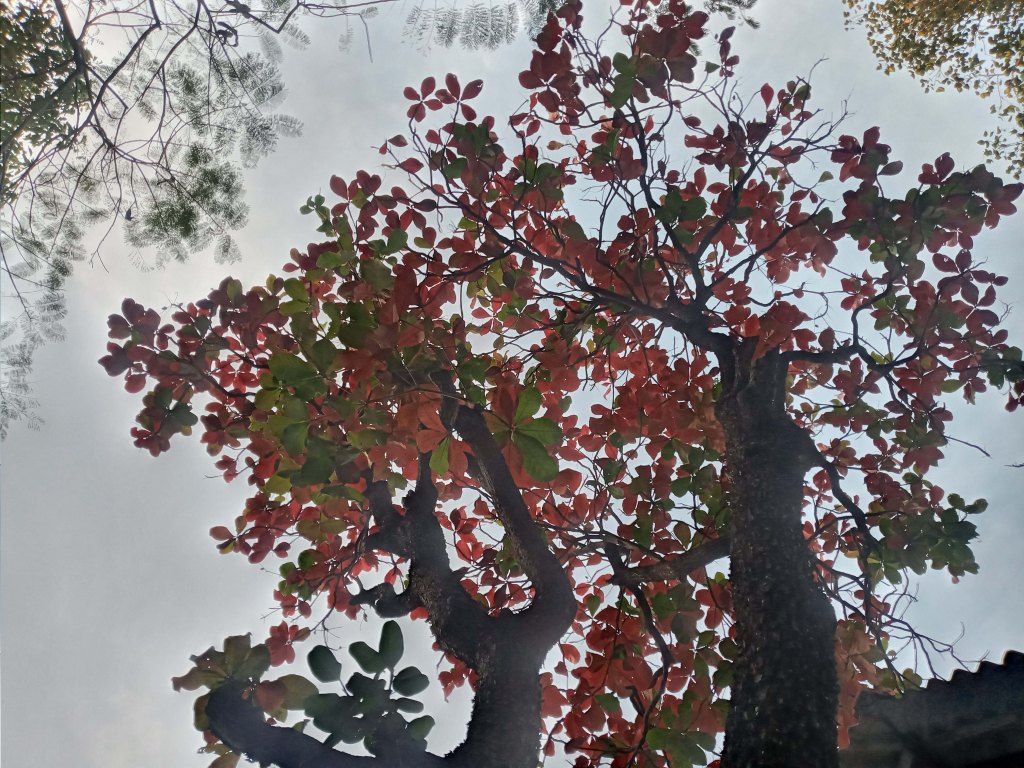
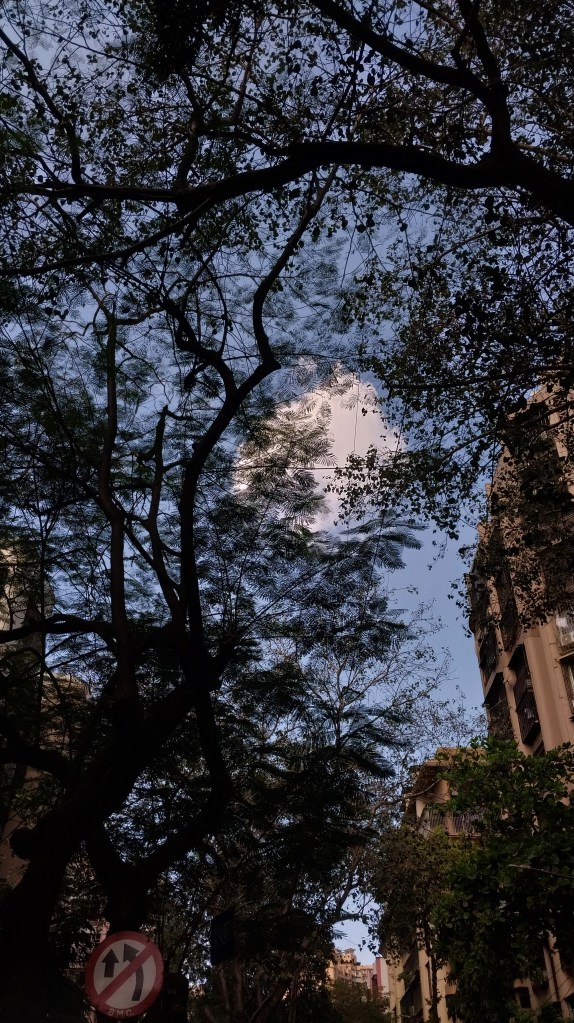
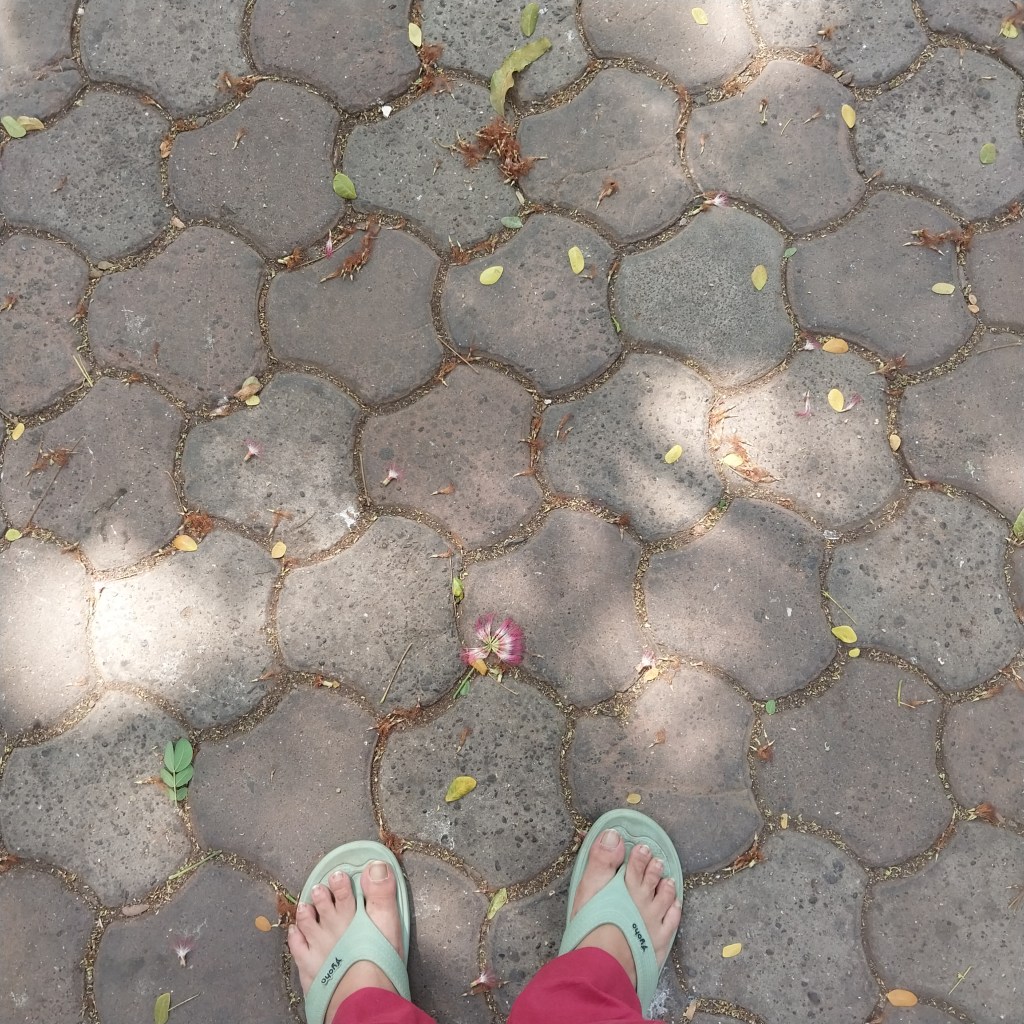
Left to right: Desi badam tree, rain tree, and flower of a rain tree.
And with all the birds that visit me, every park or stretch of the street where I can pause and just be, each tree I see standing, I think that maybe the absence of love for and attachment to a city doesn’t have to foreclose forms of love and ways of loving to be nestled in that city. And perhaps curiosity in the midst of not knowing and not-quite loving is worth striving for, whether it is in relation to where I live, what I’ve left behind, and where I might never be.
—Samprati Pani
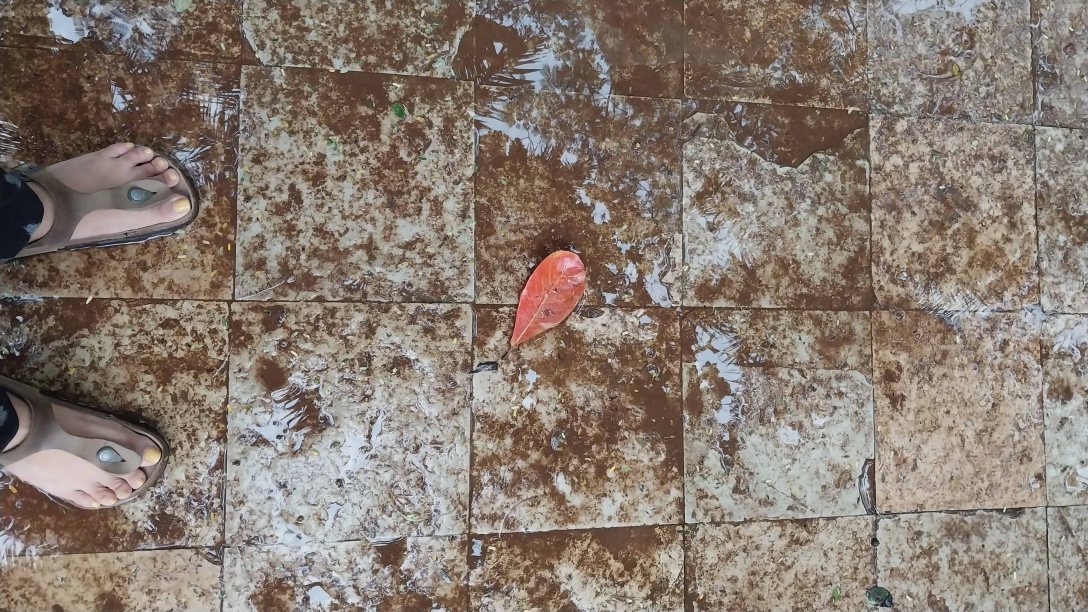
Cover photograph: Walking in the Mumbai monsoon, pausing before a leaf from the desi badam tree. All photographs by Samprati Pani.
Notes
- The term is taken from Jane Jacobs, who uses it to refer to the improvised but orderly movements and interactions between pedestrians, shopkeepers, and residents in dense neighbourhoods with a diversity of actors and commercial enterprises. In cities which serve vehicles, especially private cars, rather than walkers and people making a living on the street, Jacob’s idea of a collective and collaborative ballet becomes an impossibility, giving way instead to frictions, anxieties, and disruptions. ↩︎
- Marselin Almeida and Naresh Chaturvedi, The Trees of Mumbai, Mumbai: Bombay Natural History Society, 2006 (first edition). ↩︎

 Chiragh Dilli
Mumbai is not an easy place to love…
LikeLike