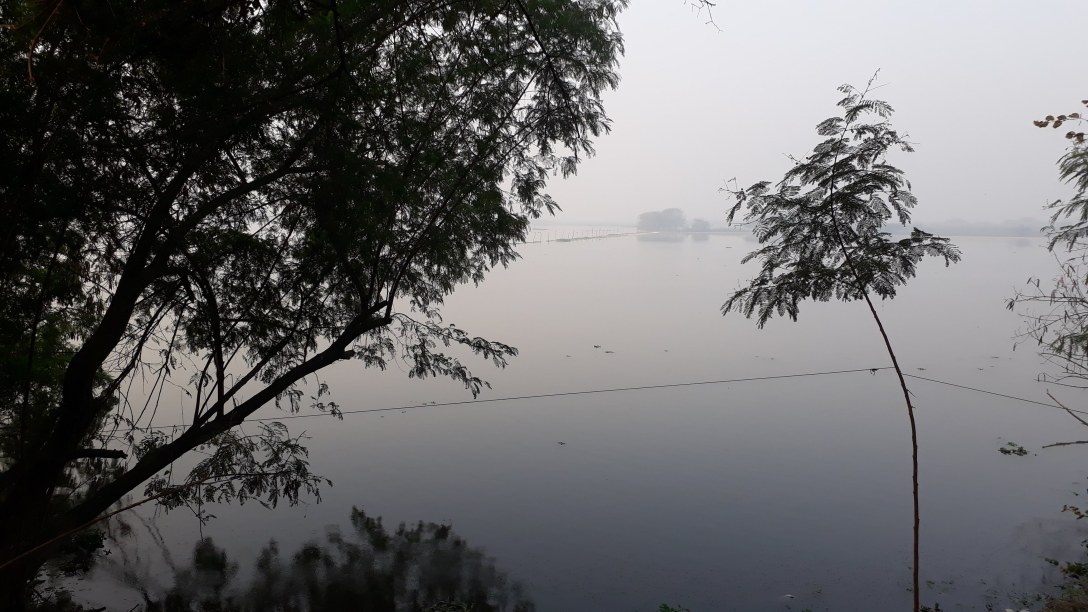
The two pieces included in this post are part of a book in progress that Sailen is writing, comprising a series of Odia short stories set in Bhubaneswar. The stories are around the theme of ephemeral and routine encounters of love, or its possibility, located in places that serve as public and private landmarks of everyday life in the city.
Chiragh Dilli matters!
The blog has taken the shape it has over these years through the love and labour, struggles and dilemmas of the two of usโSamprati and Sarover. Making something together is never simple or easy. What has kept us going is our love for writing, for cities and for creating a unique space for thinking with cities, as well as the immense support, cheering on, love and respect of our readers, guest authors and collaborators. This is not a quibble about technicalitiesโa co-founder can remain a co-founderโbut about two women taking ownership for something they have created, about not being okay with false impressions, intentionally or unintentionally, being in public circulation, about not letting their labour be appropriated.ย
When is qasbah?
The Kasba of my childhood was never a destination, let alone a subject of interest or enquiry. Nearly two decades later, when I arrived in aย qasbahย in Uttar Pradesh, I had learnt to spell it with a โqโ, the Latin equivalent of the Arabicย qaf. I had also learnt a few other things about it as a student of history. Broadly, the qasbah was distinct from aย shahrย (city) and often emerged around theย qilaย (fort) of a military commander. In some parts of the Islamic world,ย the qilaย itself was called a qasbah. Historians have variously translated the qasbah as โsmall townshipโ, โcommercial martโ, โbetween a village and a cityโ and โgarrison townโ. Indeed, qasbah has implied different kinds of settlements in different places at different points in time, and these meanings are accessed through the lenses of those who wrote about these settlements โnot as points or areas on maps, but as integrations of space and time; as spatio-temporal eventsโ.
Mumbai’s migrant gods
Thousands of shrines of varying sizes reside in the streets of Mumbai. These shrines act as markers of new settlements and localities. Most of them represent and embody the identity of the people who brought them here. But more often than not, they hold together the hopes and aspirations of migrant communities as they navigate the precarity of the life worlds that a city like Mumbai generates. The shrines act as magnets, drawing together people with shared backgrounds and attracting sometimes a set of new believers. They belong to different streams of faith, ranging from organized religions to folk, tribal and occupational forms of worship. Many of these are exclusively cared for by women like the Velankanni Matha shrines. On the other hand, roadside Hanuman shrines seem to be a favourite of young migrant men who live alone or in groups in the city.
A step in New York/A footfall in Lahore
I lived for a decade in Chicago, where I could only walk in the Midway Plaisanceโa wide boulevard with a fat-bellied, grassy middleโin Hyde Park. The 1893ย Worldโs Columbian Exhibitionย was held in Hyde Park and the Plaisance was a covered walk with concessions and private entertainment decked around it: markets from Algeria and Tunis, an โIndianโ village, an Oriental (Chinese) village and theatre, an Indian bazaar, a Moorish palace, a street in Cairo. The official guidebook told the white โwalkersโ that they should expect to bump into an โIndianโ family making their bread or a Pathan sepoy waxing his moustache. Franz Boas, later to lead Columbiaโs anthropology department, was the main force behind the 1893 Chicago Fair and had been hired by Frederic Putnam, then director of Harvard Universityโs Peabody Museum.
The future in Delhiโs present
Different parts of the city hold different meanings for those who come to live in it. The footpath to a bus stop in East Delhi, the view of Purana Qila from aย mudrika, the first ice cream at India Gate, a market, a park, a housing colony, a route or a stop accumulate to make the city for us, and in strange and invisible ways also make us.ย Yet, we continue to exist in ourselves and in cities in this constant play of the visible and ever-changing present, jousting constantly with our memories and our present navigating through a place.
Talking places
Can the new be experienced in all its dizzying and excessive newness, or do we continuously fall back on the crutches of familiarity, no matter how inept or even obsolete?ย Is it inevitable that we carry the burdensโof our familiar selves, homes and not-quite-homes, cities and livesโwhen we walk the path that can lead anywhere because we havenโt walked it ever before?
The night jasmine
I notice the night jasmine in front of my house in Bhubaneswar, after many years, when it gets infested with termites. The insects have woven a second skin around the tree. I hate termites. They eat books. I break a twigโas long as my forearm and as thin as Rumiโs little fingerโfrom the guava tree that grows just beside the night jasmine. I donโt remember whether I planted the night jasmine or if it has grown on its own.
A view from across the riverย
On the face of it, Patparganjโs apartments appear to be small islands, each holding together a set of people with a shared social background. And there are apartment dwellers, who manage to unlook and avoid the sea of life the islands are surrounded by, through the blinkers of their class and aspirations, shopping for vegetables and eating street food from the evasive confines of their cars or seeking the โhappening cityโ elsewhere. Yet, life here, as I have come to experience over the years, does not inevitably have to be one of isolated living confined to the apartments.ย
Hunny ka chuha
If it is indeed the same chuha, it is back with a vengeance. Its earlier avatar was well behaved. It would stealthily come out at night after Hunny went to sleep and would rarely leave telltale signs of its dinner, except sometimes half-eaten bananas. This one does acrobatics through all times of the day, leaping over masala jars and knocking them off, smashing Rooafza bottles, scurrying over the bookshelves, chomping on electricity bills and doing cartwheels on the sofa. It eats everything โฆ potatoes, lids of Tupperware boxes, newspapers, phone chargers, books and unopened biscuit packetsโyou name it! It prefers to shit on the bed or on freshly laundered clothes. And it is BIG.
Smell and the City III
What is it about the olfactory sense that seems to hint at absences as much as presences? Why does one recollect so many peripheral details about โthat particular smellโ but not quite the odour itself? Perhaps smell forms the base, the foundation, for our sensory memories, sending out tentacles into visions, hearings, giving then nourishment, yet ultimately laying hidden, subterranean. It is only when, for some reason, one does not use a particular sense organ that one gains faculties related to the others. This seems especially true for the sense of smell.